
Refrigerant Leak in Your Orange AC? Detection & Repair
When a July Heat Wave Exposed One Orange Family’s Hidden Problem
The Murphy family in Old Towne Orange thought their 12-year-old central air conditioner just needed a tune-up. Temperatures had climbed to 97°F, and their system couldn’t keep the house below 80°F. The Ac Repair in Orange technician found their evaporator coil encased in ice—a telltale sign of refrigerant loss. A slow leak had been robbing their system for months. By the time they called for help, the compressor was overheating and on the verge of catastrophic failure. What started as “the AC isn’t quite keeping up” nearly became a $4,500 emergency replacement in peak summer.
📋 In This Guide
💰 Typical Repair Cost Ranges
- Leak detection only: $100–$330
- Minor line set leak repair + recharge: $250–$600
- Evaporator coil replacement: $2,500–$4,500
- R-22 refrigerant (per pound): $90–$250
- R-410A refrigerant (per pound): $50–$80
This guide gives Orange homeowners a practical checklist for identifying leaks early, understanding detection methods, navigating the R-22 phase-out, and making repair-versus-replace decisions that protect both your investment and your property value.
Early Warning Signs Checklist: Spot Leaks Before Compressor Damage
Refrigerant doesn’t evaporate naturally—if levels drop, there’s always a leak. Catching it early prevents secondary damage to expensive components. Use this checklist during cooling season:
☐ Ice buildup on refrigerant lines or evaporator coil
Frost or ice forming on copper lines near the outdoor unit or visible ice on the indoor coil signals low refrigerant charge. The system struggles to absorb heat, causing temperatures to plummet below freezing at the coil surface.
☐ Hissing or bubbling sounds near the outdoor condenser
An audible hiss near refrigerant connections, service valves, or along copper line sets indicates pressurized refrigerant escaping. Larger leaks produce consistent hissing; smaller leaks may only be audible when the system first starts.
☐ Reduced cooling capacity despite thermostat settings
Rooms that used to reach 72°F now struggle to cool below 77°F. The system runs constantly but never satisfies the thermostat. This gradual decline often goes unnoticed until outdoor temperatures spike.
☐ Unexplained spike in electric bills
A system low on refrigerant forces the compressor to work harder and run longer cycles to achieve the same cooling output. Many Orange homeowners see 20–30% higher summer bills before realizing their AC has a leak.
☐ Oily residue near refrigerant connections
Refrigerant carries compressor oil through the system. Leaks often leave dark, greasy spots at connection points, service ports, or beneath coil housings. Check around the outdoor unit’s service valves and indoor coil drain pan area.
☐ Compressor short-cycling or overheating
Low refrigerant causes compressors to overheat and shut down prematurely. You’ll notice the outdoor unit turning on and off rapidly—every 5–10 minutes instead of running steady 15–20 minute cycles. This pattern accelerates compressor wear and often leads to total failure within months.
Why Chapman University Area Homes See Faster Coil Corrosion
Orange sits 12 miles inland from the coast, but marine air still reaches neighborhoods near Chapman University and Orange Civic Center during June and July. Coastal moisture combined with summer heat accelerates corrosion on evaporator and condenser coils, especially in systems over 10 years old. Homeowners in Ac Repair in Tustin and Ac Repair in Anaheim face similar corrosion patterns. A qualified hvac contractor in Orange should inspect coils annually for pitting and micro-leaks before they become emergency failures.
Professional Detection Methods: What Technicians Actually Do
Finding a refrigerant leak isn’t guesswork—licensed technicians follow systematic protocols. Here’s what you should expect during a professional inspection:
☐ Electronic leak detector scan
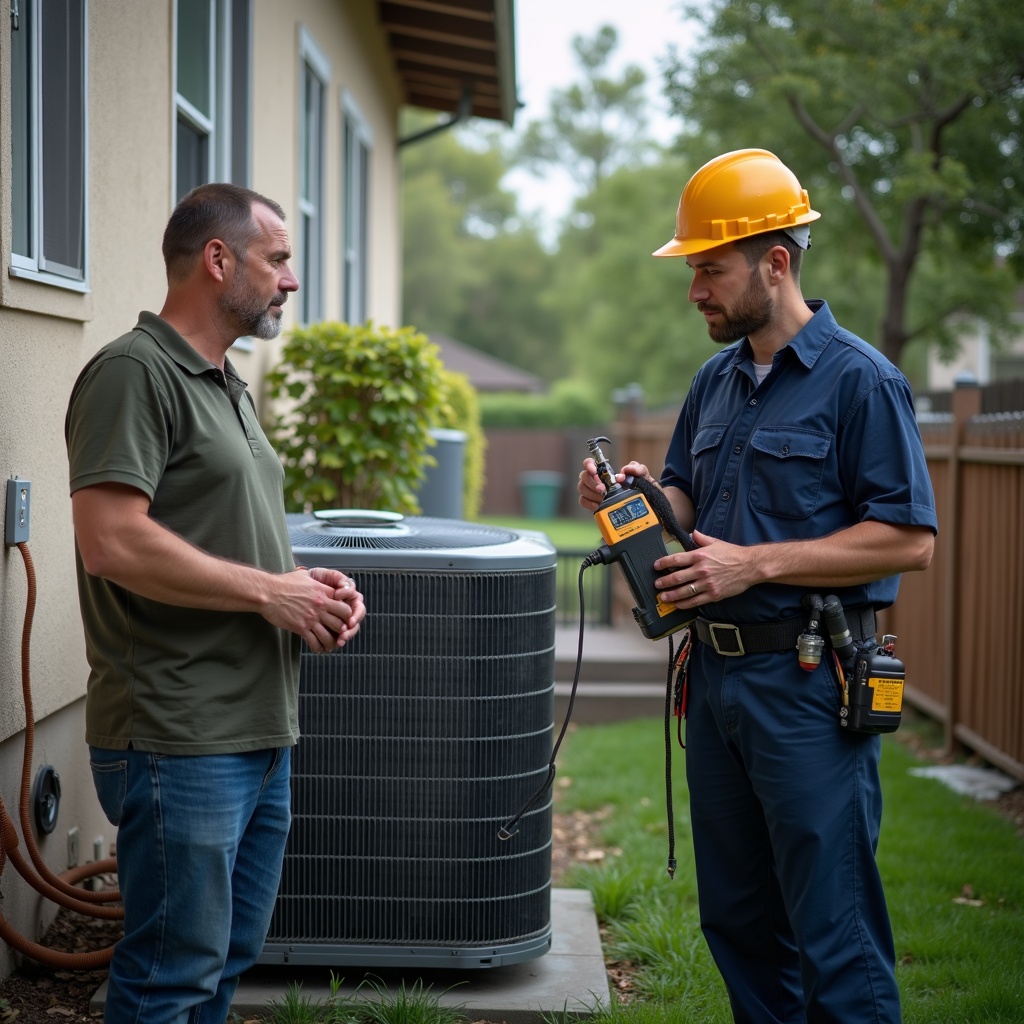
Technicians use handheld sensors that detect refrigerant molecules in concentrations as low as 0.25 ounces per year. The device beeps and lights up near leak sources. This method works best for larger leaks in accessible areas—service valves, line set connections, and outdoor coil joints.
☐ UV dye injection and inspection
For slow leaks that electronic detectors miss, technicians inject fluorescent dye into the refrigerant system. After the system runs for 30–60 minutes, a UV flashlight reveals bright yellow-green stains at leak points. This method costs more ($150–$250 additional) but pinpoints micro-leaks in coil tubing and hard-to-reach connections.
☐ Nitrogen pressure test
When a leak location remains elusive, technicians evacuate refrigerant and pressurize the system with nitrogen gas to 200–400 psi. Soap bubbles applied to suspected areas reveal even the smallest leaks. This invasive test requires refrigerant recovery and recharge, adding $200–$400 to diagnostic costs.
☐ Thermal imaging camera survey
Advanced diagnostics use infrared cameras to identify temperature anomalies across coil surfaces. Cold spots indicate restricted refrigerant flow near leak sites. Few Orange contractors invest in this equipment due to the $3,000–$8,000 camera cost, but it’s invaluable for complex commercial systems.
| Detection Method | Best For | Typical Cost | Accuracy |
|---|---|---|---|
| Electronic Detector | Accessible connection points, valves | $100–$200 | 85–90% |
| UV Dye Test | Slow leaks, coil tubing | $150–$330 | 90–95% |
| Nitrogen Pressure | Hidden leaks, system-wide test | $200–$400 | 95–98% |
| Thermal Imaging | Large coil assemblies, commercial | $250–$500 | 92–97% |
Common Leak Locations in Orange Central Air Systems
Not all leaks occur in the same places. Knowing where failures typically happen helps you set realistic repair expectations:
☐ Evaporator coil (indoor unit)
Thin aluminum fins and copper tubing corrode from the inside due to formaldehyde off-gassing from building materials, or from the outside due to condensation and airborne contaminants. Coils in Orange Heights homes built in the 1970s–1990s often fail at 12–15 years. Replacement costs $2,500–$4,500 when out of warranty.
☐ Condenser coil (outdoor unit)
Exposure to sprinkler overspray, landscaping chemicals, and coastal humidity causes pitting corrosion. Many Orange homeowners unknowingly blast outdoor units with fertilizer-laden water during lawn care. Condenser coil replacement runs $900–$2,300.
☐ Refrigerant line set connections
Brazed joints at the outdoor unit service valves and indoor coil connections weaken over time from thermal expansion and vibration. These are the best-case scenario leaks—often repairable for $250–$500 including recharge.
☐ Service valves and Schrader ports
The valve cores where technicians connect gauges and add refrigerant can develop slow leaks from repeated service or degraded seals. Replacing valve cores costs $80–$150, but if the valve body itself is damaged, you’re looking at $200–$400.
☐ Compressor housing (catastrophic failure)
Internal compressor leaks indicate terminal failure. These can’t be repaired—only replaced. Compressor replacement costs $1,800–$2,800 on systems using R-410A, but for R-22 systems, replacement rarely makes financial sense versus a new system.
Why You Should Never Use DIY Leak Sealants
Over-the-counter “stop leak” products promise easy fixes, but they clog metering devices, coat coil surfaces, and contaminate refrigerant. Professional reclamation equipment can’t process refrigerant containing sealants, meaning your contaminated refrigerant must be destroyed rather than recycled. This adds $50–$150 to future repairs and voids most manufacturer warranties. Any legitimate hvac contractor in Orange will refuse to service a system after homeowners use these products.
R-22 Phase-Out Reality: Conversion Options for Orange Homeowners
If your system was installed before 2010, it likely uses R-22 refrigerant (often called “Freon”). Understanding your options prevents panic decisions during breakdowns:
☐ Check your refrigerant type
Look for a metal data plate on the outdoor condenser unit. It lists refrigerant type as “R-22,” “HCFC-22,” or “Chlorodifluoromethane.” Systems labeled “R-410A” or “Puron” use the newer refrigerant and aren’t affected by R-22 restrictions.
☐ Understand current R-22 costs
Production ended in 2020. Remaining supplies come from recycled refrigerant stockpiles. Prices in 2026 range from $90–$250 per pound installed. A typical 3-ton residential system needs 6–9 pounds for a full recharge, meaning you could pay $750–$2,250 just for refrigerant—before leak repair costs.
☐ Consider drop-in refrigerant alternatives
Some contractors offer R-407C or MO-99 as R-22 substitutes. These blends work in existing systems with minimal modifications (oil change, filter-drier replacement). Conversion costs $800–$1,500, but performance typically drops 5–10% and you still have an aging system with a patched leak.
☐ Calculate the replacement threshold
Use this formula: (Repair cost + refrigerant cost) × (System age ÷ 10). If the result exceeds $5,000, replacement delivers better long-term value. Example: A 14-year-old system needing a $1,200 coil replacement plus $800 in R-22 refrigerant = $2,000 × 1.4 = $2,800. This is below the replacement threshold, but factor in likely future repairs within 2–3 years.
☐ Explore new system efficiency gains
R-22 systems built before 2010 operate at 8–12 SEER efficiency. Current minimum standards require 15 SEER2, with high-efficiency models reaching 18–21 SEER2. A new system using R-454B refrigerant (the 2026 standard) reduces cooling costs 30–40% while adding 15–20 years of reliable service. For a $900,000 home in Orange, that efficiency and reliability protects property value.
California EPA Refrigerant Regulations: What Orange Homeowners Must Know
Environmental compliance isn’t optional—federal and state laws govern refrigerant handling with significant penalties for violations. Make sure any contractor you hire follows these requirements:
☐ Verify EPA Section 608 certification
Federal law requires all technicians who handle refrigerants to hold EPA Section 608 certification. This is not negotiable—ask to see the certification card before work begins. Unlicensed handling carries fines up to $44,539 per violation as of 2026.
☐ Require refrigerant recovery, not venting
Technicians must use recovery machines to capture refrigerant before opening the system. Deliberately venting refrigerant to atmosphere violates the Clean Air Act. Legitimate contractors invest $1,500–$3,000 in recovery equipment because it’s required, not optional.
☐ Understand 2026 AIM Act leak repair requirements
For systems containing 15 pounds or more of HFC refrigerant (R-410A, R-454B), new rules effective January 1, 2026, require leak rate calculations every time refrigerant is added. If annual leak rates exceed 10% for comfort cooling systems, repairs must be completed within 30 days or the system must be retrofitted or retired. This affects larger residential systems and all commercial installations.
☐ Request proper refrigerant disposal documentation
Recovered R-22 must be reclaimed to purity standards or properly destroyed. As of January 1, 2026, refrigerant cannot be sold as “reclaimed” if it contains more than 15% virgin refrigerant by weight. Reputable contractors provide documentation showing proper disposal or reclamation.
☐ Know California-specific restrictions
California Air Resources Board (CARB) regulations layer on top of federal EPA rules. While the federal threshold for leak repair requirements is 15 pounds, California maintains some additional reporting requirements for commercial refrigeration. Residential homeowners aren’t directly affected, but your HVAC services in Orange contractor must comply with both sets of rules.
What the New Refrigerant Standards Mean for 2026 Repairs
R-410A, the refrigerant used in systems installed between 2010–2024, is also being phased down under EPA Technology Transitions rules. New systems manufactured after January 1, 2025, use A2L refrigerants like R-454B or R-32 with significantly lower global warming potential. The good news: R-410A remains available for servicing existing systems, and supplies should remain adequate through the 2030s. Unlike the R-22 phase-out, you won’t see dramatic price spikes on R-410A in the near term.
Repair vs. Replace Decision Matrix for Orange Homeowners
Not every leak justifies replacement, but not every repair makes financial sense. Use this decision framework:
☐ System age and expected remaining lifespan
Central air conditioners last 15–20 years with proper maintenance. If your system is 12+ years old and needs major refrigerant system repairs, you’re paying substantial money for potentially only 3–5 years of additional service. Systems under 8 years old with isolated leaks typically justify repair.
☐ Apply the 50% rule
If total repair costs (including leak detection, parts, labor, and refrigerant recharge) exceed 50% of new system replacement cost, replacement typically delivers better value. New central air systems for Orange homes range from $5,000–$8,300 installed, depending on capacity and efficiency. A $3,000 repair on a 13-year-old system fails this test.
☐ Factor in energy cost savings
With Southern California Edison’s tiered summer rates, an inefficient old system costs $150–$250 monthly during July–September. A high-efficiency replacement drops that to $100–$160 monthly—a $600–$1,100 annual savings that pays back 20–30% of the replacement cost over the first five years.
☐ Consider repair history and pattern
One refrigerant recharge might be an isolated incident. Multiple recharges over 2–3 years indicate systemic problems—ongoing leaks, poor installation quality, or component corrosion. If you’ve added refrigerant twice in the past three years, replacement prevents ongoing repair cycles.
☐ Evaluate home value and sale timeline
In Orange’s $900,000 median home market, HVAC systems significantly impact buyer confidence. A new, high-efficiency system with 10-year parts warranty becomes a selling point. A patched 14-year-old system with disclosed refrigerant leak history triggers buyer concerns and inspection issues. If you’re selling within 3–5 years, replacement protects the transaction.
☐ Check warranty coverage
Manufacturers typically provide 5–10 year parts warranties. If your evaporator coil or condenser coil is leaking and still under warranty, you only pay labor costs ($800–$1,500) for replacement. This changes the repair economics significantly. Always check warranty status before deciding on major repairs versus replacement.
Shalom Heating & Air serves Orange homeowners with transparent refrigerant leak diagnostics, repair, and replacement services. We provide detailed written estimates that break down detection costs, repair options, and replacement alternatives so you can make informed decisions. Our EPA-certified technicians handle all refrigerant work in compliance with federal and California regulations. Call (714) 886-2021 for same-day leak detection service or to schedule a free replacement consultation for systems showing chronic refrigerant loss.
