
Cut Cypress Summer Cooling Costs Before Peak Heat Hits
Why April Is Your Last Chance to Lock in Summer Energy Savings
Cypress homeowners face a critical window right now. Electricity costs in Cypress currently sit at 30 cents per kilowatt-hour, roughly 49% higher than the national average, and Southern California Edison’s latest rate filing shows electricity costs are expected to rise 12.9% in 2026. With summer temperatures typically reaching the 90s and occasionally pushing past 100 degrees from June through September, waiting to implement energy-saving strategies means you’ll pay hundreds more than necessary. Every week you delay means missing out on cumulative savings that compound throughout the entire cooling season.
📋 In This Guide
The math is stark: a typical Cypress home running air conditioning 8-10 hours daily during peak summer can easily consume 1,200-1,500 kWh per month. At current rates, that translates to $360-$450 monthly just for cooling. But households that optimize their HVAC systems and habits before summer arrives consistently reduce those bills by 15-25%. For a family in HVAC services in Cypress neighborhoods like Cypress Village or College Park, that represents $650-$1,100 in annual savings—money that stays in your pocket instead of disappearing into the grid during those brutal July and August afternoons when temperatures hover near triple digits.
1. Schedule Your AC Tune-Up Now—Not When It’s Already Failing
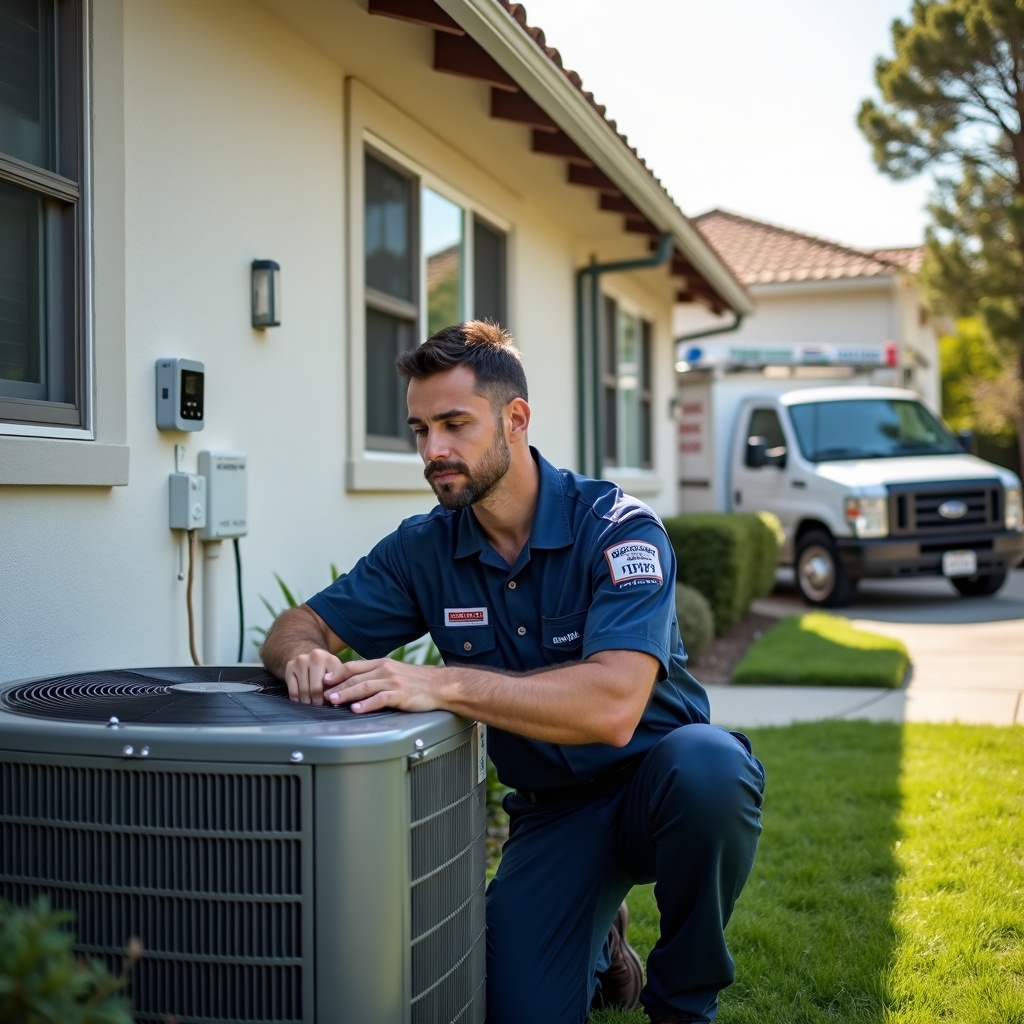
The single most cost-effective move Cypress homeowners can make happens before the heat wave hits. An AC tune-up costs $70 to $200 for basic maintenance, but this modest investment prevents catastrophic failures and efficiency losses that cost exponentially more. Professional maintenance performed in April or early May addresses the wear accumulated over the previous year before your system enters its highest-demand period.
During a comprehensive tune-up, an hvac contractor in Cypress will clean condenser coils caked with dust and pollen, check refrigerant levels that may have dropped due to minor leaks, replace worn capacitors before they fail on a 98-degree Saturday afternoon, and calibrate thermostat sensors that have drifted over time. Each of these issues independently reduces cooling efficiency by 5-15%. When multiple problems compound, your system can lose 30-40% of its designed capacity—meaning it runs constantly, struggles to cool your home, and drives your electricity bill through the roof.
The timing matters because AC repair in Cypress demand skyrockets once temperatures climb. Book your tune-up in April, and you’ll get convenient scheduling and thorough service. Wait until June when your system struggles during a heat wave, and you’re competing with hundreds of other homeowners for emergency service slots, often paying premium rates for rushed repairs. Regular maintenance also extends equipment lifespan from 8-12 years to 15-20 years, deferring the $5,000-$8,000 replacement cost that catches unprepared homeowners by surprise.
What a Proper Tune-Up Should Include
Not all maintenance visits are equal. A legitimate pre-season service should examine air filters, inspect and clean both indoor evaporator coils and outdoor condenser coils, verify proper refrigerant charge, test electrical connections and voltage, lubricate moving parts, clear condensate drains, calibrate thermostats, and measure airflow across the system. This comprehensive approach catches the 90% of problems that develop gradually rather than catastrophically—the issues that silently drain efficiency for months before causing complete failure.
2. Upgrade to a Smart Thermostat for Automatic Optimization
Programmable thermostats have existed for decades, but one of the best and least used tools for energy savings is programming your thermostat, but many programmable thermostats are just set to stay at one temperature all the time because people don’t know how to manually create an energy-efficient schedule, or find it too complicated. Smart thermostats solve this problem through learning algorithms that adapt to your actual patterns rather than requiring manual programming.
On average, smart thermostats deliver approximately 8% savings on heating and cooling bills or $50 per year, though savings may be greater depending on climate, personal comfort preferences, occupancy, and HVAC equipment. In Cypress’s hot climate with extended cooling seasons and high electricity rates, actual savings typically range from $100-$180 annually. According to data from independent studies of actual Nest customers, smart thermostats can, on average, save customers between 10-12 percent on heating and 15 percent on cooling.
The real value comes from features traditional thermostats can’t match: geofencing that detects when you leave home and automatically adjusts temperatures, weather-responsive algorithms that pre-cool during cheaper morning hours before afternoon heat arrives, and remote access that lets you adjust settings from your smartphone when plans change. For Cypress families with irregular schedules or those who frequently leave home for work, sports, or activities, these automated adjustments eliminate the wasted energy from cooling an empty house to 72 degrees all day.
Installation costs range from $120-$350 depending on the model and whether you need a C-wire adapter, but many Southern California Edison customers qualify for rebates through demand response programs. When you factor in utility incentives plus annual energy savings, most Cypress homeowners achieve full payback within 12-18 months. An hvac company in Cypress can assess your system’s compatibility and recommend models that integrate properly with your existing equipment.
3. Leverage Time-of-Use Rates to Shift Cooling Demand
Southern California Edison’s time-of-use rate structure creates massive savings opportunities for homeowners who understand when electricity costs peak. SCE’s TOU-D-4-9PM rate plan has an on-peak window of 4 pm to 9 pm, in which electricity costs 58 cents per kWh, while the summer weekday rate in the TOU-D-5-8PM plan reaches 74 cents per kWh, compared to the average utility rate in the US of around 19 cents per kWh.
The strategy is straightforward: pre-cool your home during cheaper mid-peak and off-peak hours (typically 8 AM to 4 PM), then rely on thermal mass and minimal system cycling during expensive peak periods. Set your smart thermostat to reach 70-72 degrees by 3:30 PM, then allow temperature to drift to 76-78 degrees during the 4-9 PM peak window. Your home’s insulation and thermal mass will maintain comfort for several hours without running the AC during the most expensive part of the day.
For a typical Cypress home consuming 40 kWh of cooling energy daily during summer, shifting just 60% of that demand away from peak hours saves $8-12 per day, or $240-360 per month during June through September. This single behavioral change, automated through your smart thermostat, can offset the entire cost of the device within one summer while requiring zero sacrifice to comfort—you’re simply cooling the same amount, but timing it strategically.
4. Optimize Airflow with Strategic Ceiling Fan Use
You can save as much as 10% a year on heating and cooling by simply turning your thermostat back 7-10°F for 8 hours a day from its normal setting, but ceiling fans allow you to maintain the same perceived comfort at higher thermostat settings. The wind-chill effect makes 78 degrees with a ceiling fan feel identical to 72 degrees without airflow, yet the energy consumption difference is dramatic.
Each degree you raise your thermostat during Cypress summer reduces cooling costs by approximately 3-5%. By running ceiling fans in occupied rooms and setting your AC to 76-78 degrees instead of 70-72 degrees, you achieve 18-30% energy reduction while maintaining equivalent comfort. A ceiling fan consumes roughly 30-75 watts compared to 2,000-5,000 watts for a central AC system—you’re replacing expensive cooling with pennies worth of fan operation.
The critical mistake homeowners make is running fans in unoccupied rooms. Fans cool people through evaporative wind chill, not by lowering air temperature. Running a fan in an empty bedroom wastes electricity and generates heat from the motor. Train family members to turn fans off when leaving rooms, or install smart switches that automatically shut off fans after 30-60 minutes of no detected motion.
Proper Fan Direction Matters
Verify your ceiling fans rotate counterclockwise during summer months when viewed from below. This pushes air downward, creating the cooling breeze effect. Many homeowners unknowingly leave fans set to winter mode (clockwise rotation), which pulls air upward and provides zero cooling benefit while still consuming electricity. The small switch on the fan motor housing controls direction—a 10-second adjustment that many Cypress homes overlook.
5. Address Window Heat Gain Before Summer Intensity Arrives
West and south-facing windows in Cypress homes absorb tremendous solar radiation during summer afternoons. A single large west-facing window can introduce 1,000-1,500 BTUs of heat per hour during peak sun exposure—equivalent to running a small space heater inside your home while simultaneously trying to cool it. This solar heat gain forces your AC to work dramatically harder, consuming 15-25% more electricity than properly shaded homes.
Cellular or honeycomb shades provide the best balance of light control, insulation value, and cost-effectiveness. Top-down/bottom-up models let you maintain privacy and natural light while blocking direct sun on west-facing windows during 2-7 PM when solar intensity peaks. Reflective window film offers a permanent solution for problematic exposures, rejecting 50-70% of solar heat while maintaining visibility. Professional installation runs $8-12 per square foot, but a single large window treatment can reduce localized cooling load by 500-800 BTUs hourly.
Exterior shading proves even more effective because it intercepts solar radiation before it reaches the glass. Retractable awnings on south and west exposures, shade screens, or strategically planted trees create microclimates that lower ambient temperatures around your home. Homes near Oak Knoll Park benefit from mature tree cover, but newer construction in developments like Sorrento often lacks adequate natural shading and requires deliberate intervention.
Don’t overlook the cumulative impact of multiple small windows. That collection of four 2×3-foot windows on your home’s west side collectively introduces as much heat as one large picture window. Treating all west and south-facing glass—not just the biggest windows—delivers proportional energy savings and dramatically improves comfort in affected rooms during late afternoon hours when Cypress temperatures peak.
6. Seal Air Leaks and Improve Insulation Efficiency
Conditioned air escaping through gaps around doors, windows, attic access panels, and ductwork represents pure waste—you’ve already paid to cool that air, and it’s leaking directly outdoors while drawing in hot exterior air to replace it. Professional energy audits consistently identify 15-30% of total cooling energy lost to air leakage in typical California homes built before 2000.
Focus first on the biggest culprits: attic access hatches (which often lack weatherstripping and allow massive air exchange), gaps around window and door frames (especially older aluminum-frame windows common in Cypress homes from the 1970s-1990s), and ductwork joints in unconditioned spaces. A single unsealed attic hatch can leak 200-400 cubic feet of conditioned air per hour—continuously, 24/7, throughout the cooling season. Weatherstripping and foam gasket tape cost $15-30 and install in 20 minutes, yet deliver $80-150 in annual energy savings.
Attic insulation proves equally critical because inadequate coverage allows radiant heat from your roof deck to migrate into living spaces. Cypress attics routinely reach 140-160 degrees during summer afternoons, and insufficient insulation (less than R-30 in most climate zones) transfers this heat downward, forcing your AC to combat both outdoor air temperature and radiant ceiling heat simultaneously. Boosting attic insulation to R-38 or R-49 costs $1.50-$3.00 per square foot but reduces cooling loads by 20-35% in two-story homes with significant roof area.
Duct sealing delivers another often-overlooked gain. If your supply and return ducts run through the attic (common in Cypress homes), any leaks dump expensive conditioned air into 150-degree attic space while pulling superheated air into your return system. Professional duct sealing with mastic and metal tape—not standard duct tape, which degrades rapidly—costs $300-600 for a typical home but improves delivered cooling efficiency by 15-25%. Many homeowners pursuing indoor air quality in Cypress improvements discover significant duct leakage during inspection and address both issues simultaneously.
Take Action Before Peak Cooling Season Begins
These six strategies work synergistically—each improvement compounds the benefits of others. A home with a properly maintained AC, smart thermostat programming, strategic time-of-use cooling, effective window treatments, sealed air leaks, and adequate insulation can reduce summer cooling costs by 30-45% compared to a baseline home taking no optimization steps. For the typical Cypress household facing $400-500 monthly summer electricity bills, that represents $120-225 in monthly savings, or $500-900 over a four-month cooling season.
The critical factor is timing. Implementing these measures in April and May allows you to capture maximum savings across the entire summer. Waiting until July when your first $450 electricity bill arrives means you’ve already surrendered half the potential savings. Similarly, scheduling AC maintenance now ensures your system performs optimally when you need it most, rather than discovering a failing capacitor or low refrigerant on the hottest weekend of the year when AC repair in Cypress companies face multi-day backlogs.
Shalom Heating & Air helps Cypress homeowners implement comprehensive energy-saving strategies tailored to your specific home characteristics, HVAC equipment, and comfort priorities. Our technicians assess your system’s current efficiency, identify the highest-ROI improvements for your situation, and provide transparent pricing for both immediate tune-ups and longer-term upgrades. Call (714) 886-2021 to schedule your pre-summer AC optimization and start saving before the first heat wave hits.
| Energy Strategy | Typical Cost | Annual Savings | Payback Period |
|---|---|---|---|
| Professional AC Tune-Up | $70–$200 | $150–$300 | 3–8 months |
| Smart Thermostat Installation | $120–$350 | $100–$180 | 9–18 months |
| Window Shading/Film | $200–$600 | $120–$250 | 12–24 months |
| Air Sealing & Weatherstripping | $150–$400 | $180–$350 | 6–14 months |
| Attic Insulation Upgrade | $1,200–$2,500 | $300–$550 | 2–4 years |
