
Why Your Central AC Won’t Cool La Palma Homes: 9 Causes
What Happens When You Ignore a Central Air Conditioner That Won’t Cool
When your central air conditioner runs but doesn’t cool your La Palma home, ignoring the problem doesn’t just mean discomfort during Southern California’s peak summer heat. A ripple effect on your system can lead to pricey repairs, inefficient performance, and even total system breakdowns that leave you without air conditioning—and in the worst cases, refrigerant leaks or electrical malfunctions can create genuine safety hazards. For the 76% of La Palma homeowners who own their $900,000 properties, a failing central AC system represents both a comfort crisis and a significant threat to home value. The urgency isn’t just about staying cool—it’s about preventing a $300 repair from becoming a $3,000 replacement.
📋 In This Guide
💰 Typical AC Repair Cost Ranges
- Refrigerant leak repair & recharge: $300–$1,500
- Compressor replacement: $1,800–$2,800
- Evaporator coil replacement: $1,900–$3,000
- Condenser coil cleaning: $150–$400
- Thermostat replacement: $150–$450
This guide examines the nine most common reasons your central air conditioner runs but fails to cool your home, with specific temperature benchmarks for Southern California’s climate, DIY diagnostic steps you can safely perform, and clear indicators when you need professional help from an AC repair in La Palma specialist. Every minute your system operates inefficiently costs you money and increases the risk of catastrophic failure.
Understanding the Cooling Performance Benchmark for La Palma Climate
Before diagnosing why your central air conditioner won’t cool effectively, you need to understand what “effective cooling” actually means in La Palma’s Mediterranean climate. A properly functioning AC system should maintain indoor temperatures 20–25°F below outdoor ambient temperature. When outdoor temperatures reach 95°F during peak summer afternoons—common in this area—your system should achieve indoor temperatures of 70–75°F. If your thermostat shows 82°F or higher while the outdoor condenser runs continuously, you have a legitimate cooling problem that requires immediate attention.
The age and square footage of your home also matter significantly. Many properties in the Walker Street Area and Central La Palma neighborhoods were built decades ago with HVAC systems designed for smaller cooling loads. Modern window replacements, added insulation, and even landscape changes affect how your system performs. An undersized system—even one operating perfectly—will struggle during extreme heat events, while an oversized system will short-cycle and fail to remove humidity effectively.
La Palma’s proximity to coastal areas means homeowners face unique challenges from Santa Ana winds in Cypress that bring hot, dry conditions, followed by marine layer moisture that can affect system components differently than in inland communities. Understanding these local climate factors helps you distinguish between a system working at capacity versus one with genuine mechanical failures requiring repair.
Cause #1: Refrigerant Leaks—The Silent System Killer
Refrigerant doesn’t “run low” through normal operation—your central AC operates in a sealed system. If refrigerant levels drop, you have a leak, and AC freon leak repair costs range from $250 to $1,600 on average, with homeowners paying an average of $800, depending on the leak’s location, AC unit type, and refrigerant used. The danger isn’t just the repair cost—it’s what happens when you keep running the system while it’s low on refrigerant.
Why Refrigerant Leaks Cause Cascading Damage
When refrigerant levels drop below the manufacturer’s specified charge, your compressor—the heart of your AC system—must work exponentially harder to achieve the same cooling effect. Low refrigerant stresses and overworks the compressor, causing the compressor’s components to wear out more quickly and causing critical damage to important internal parts. What starts as a $400 leak repair can quickly become a $2,000 compressor replacement if ignored for even a few weeks of regular operation.
Common leak locations include evaporator coils (inside your air handler), condenser coils (outside unit), or connection points along refrigerant lines. Older systems using R-22 refrigerant face particularly expensive repairs—R-22 has been phased out and now costs $180–$600 just for the refrigerant refill after repairs. Modern systems using R-410A are more affordable but still require EPA-certified technicians to legally handle refrigerant.
DIY Check vs. Professional Diagnosis
You can check for obvious signs: ice buildup on refrigerant lines, hissing sounds near the outdoor unit, or oily residue around connections. However, the cost to find an AC leak is $100 to $330, depending on the test method used by professionals who employ electronic detectors, UV dye tests, or nitrogen pressure tests. Never attempt to add refrigerant yourself—federal law requires Section 608 certification, and improper handling creates environmental and safety hazards.
Cause #2: Dirty Condenser Coils Blocking Heat Transfer
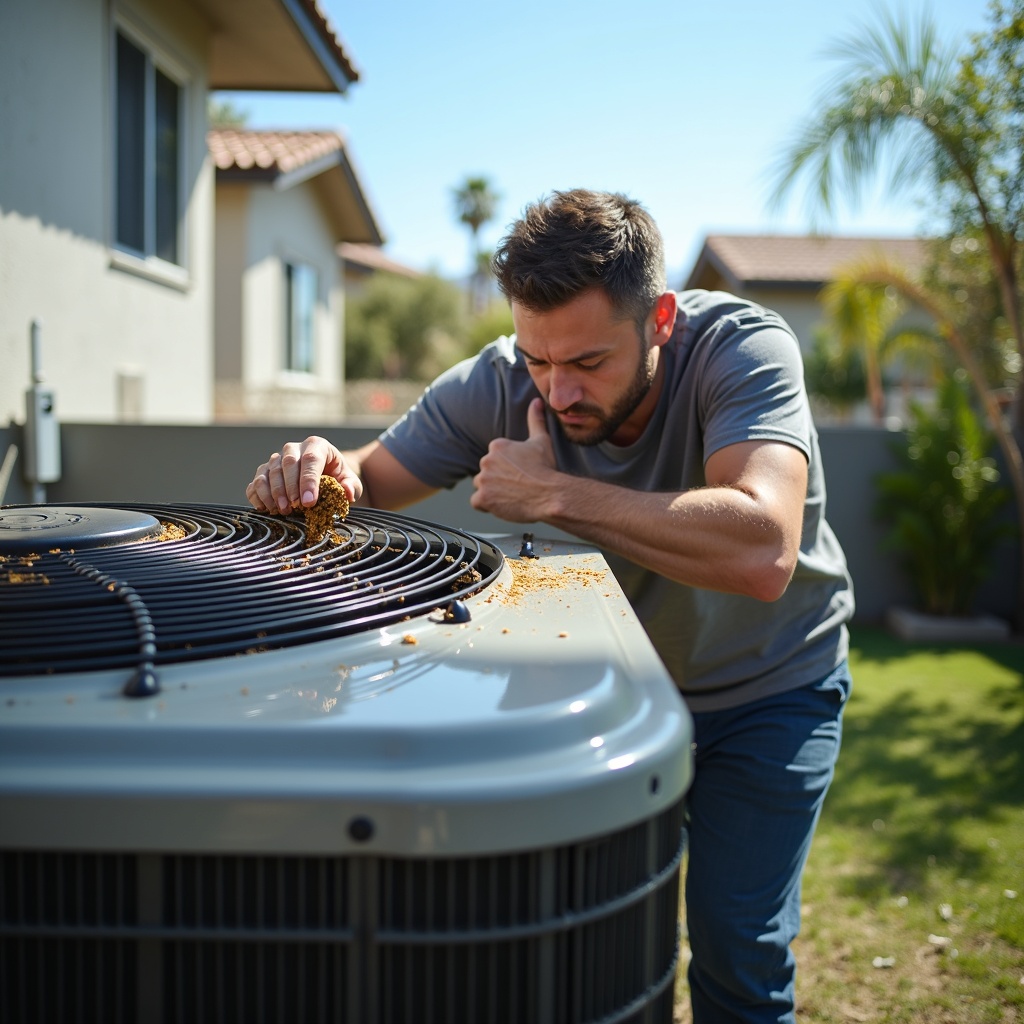
Your outdoor condenser unit’s coils must transfer heat from inside your home to the outside air—a process that fails when coils become coated with dirt, pollen, cottonwood seeds, and the fine dust that settles during La Palma’s dry summer months. Homeowners near Central Park or properties with mature landscaping face accelerated coil fouling from organic debris. The result: your system runs continuously but can’t reject heat effectively, leading to insufficient cooling and skyrocketing energy bills.
Visual inspection provides immediate clues. Turn off power to your outdoor unit, remove the top grille or side panels, and examine the fins. If you can’t see light through the coil fins, or if they’re visibly packed with debris, cleaning is overdue. Bent fins also restrict airflow—these delicate aluminum plates can be damaged by pressure washers, hail, or overly aggressive cleaning attempts by well-meaning homeowners.
Professional condenser coil cleaning typically costs $150–$400 and should be performed annually in La Palma’s climate. An experienced HVAC services in La Palma technician uses specialized coil cleaners and fin combs to restore proper heat transfer without damaging components. This preventive maintenance extends system life and improves efficiency by 15–20% in heavily fouled systems. Attempting DIY cleaning with a garden hose often bends fins and pushes debris deeper into coil layers.
Cause #3: Clogged Air Filters Strangling Your System
The single most common cause of reduced cooling performance—and the easiest to fix—is a clogged air filter. When airflow across your evaporator coil drops below design specifications, the coil temperature plummets, moisture freezes, and ice buildup further restricts airflow in a destructive cycle. La Palma homeowners who maintain indoor air quality in La Palma through regular filter changes prevent 90% of airflow-related cooling problems.
Check your filter location—typically in a return air grille, furnace cabinet, or dedicated filter rack. If you can’t see light through the filter when held up to a bulb, or if visible dust and debris coat the surface, replacement is overdue. Homes with pets, nearby construction, or residents with allergies may need monthly filter changes rather than the standard 90-day interval. High-efficiency MERV 11–13 filters capture more particles but also require more frequent replacement to prevent pressure drop.
The cost impact is dramatic: a $5 filter change prevents problems that cascade into frozen coils requiring emergency service calls ($150–$300) or damaged blower motors ($400–$800). Homeowners can lower summer energy bills by 5–15% through proper filter maintenance alone. Set a smartphone reminder for the first day of each month—the five minutes you invest checking and changing filters literally saves thousands in prevented repairs.
Cause #4: Frozen Evaporator Coils Creating a Cooling Paradox
Finding ice on your AC components during a heat wave seems counterintuitive, but frozen evaporator coils are a common cooling failure mode. The coil—located inside your air handler or furnace cabinet—should maintain temperatures just above freezing (typically 40–45°F) while removing heat and humidity from air passing over it. When airflow restrictions, refrigerant problems, or control failures cause coil temperature to drop below 32°F, condensation freezes, building up layers of ice that completely block airflow.
The Three Primary Causes of Coil Freezing
Restricted airflow from clogged filters, closed supply vents, or blocked return grilles is the most common cause. The second cause is low refrigerant charge from leaks—less refrigerant means lower evaporator pressure and temperature. Third, failed blower motors or capacitors reduce air velocity across the coil. All three conditions share a common result: your system runs but produces no cooling because frozen coils prevent air from contacting cold surfaces.
If you discover frozen coils, turn off your AC immediately and switch your thermostat to “fan only” mode to accelerate thawing. This process takes 2–8 hours depending on ice thickness. Never chip ice off coils or use heat guns—both methods damage the delicate fins and copper tubing. Once thawed, address the underlying cause: replace filters, check for closed vents, or call for professional refrigerant testing. Repeatedly running a system with frozen coils damages the compressor through liquid refrigerant slugging.
Evaporator coil replacement costs $1,000 to $2,500 on average if the unit is still under warranty and $2,500 to $4,500+ if it’s no longer under warranty. For La Palma homeowners with older systems past warranty periods, severe coil damage from prolonged freezing cycles may necessitate this expensive repair.
Cause #5: Failed Compressor—When the Heart Stops Pumping
The compressor is your AC system’s heart, pumping refrigerant through the cooling cycle. When it fails, your outdoor unit may hum, click, or remain completely silent while producing zero cooling. AC compressor replacement costs typically range between $800 and $2,300, with homeowners paying an average of $1,550 for both the compressor unit itself and professional installation. For many systems over 10 years old, compressor failure signals it’s time to replace the entire system rather than repair.
Warning signs precede total compressor failure: hard starting (lights dimming when the AC kicks on), short cycling (running for only minutes before shutting off), or unusual noises like grinding or screeching from the outdoor unit. These symptoms indicate internal compressor damage or failed start components like capacitors and contactors. An experienced hvac contractor in La Palma can diagnose whether your system needs a simple capacitor ($150–$400) or complete compressor replacement.
The Repair vs. Replace Decision
Calculate your system’s age multiplied by the repair cost. If this number exceeds $5,000, replacement typically makes more financial sense than repair. For example, a 12-year-old system needing a $1,800 compressor yields 12 × $1,800 = $21,600—well above the threshold. A new high-efficiency system costs $4,500–$8,000 installed but includes full warranty coverage, 30–50% better efficiency, and modern features like variable-speed operation and smart thermostat compatibility.
Compressor failures rarely occur in isolation. Low refrigerant from undetected leaks, dirty coils forcing excessive head pressure, or inadequate maintenance create conditions that kill compressors prematurely. If your 15-year-old system needs a compressor, it likely needs condenser coil replacement, refrigerant line repairs, and indoor coil service—costs that quickly approach new system pricing. An honest contractor will present both options with transparent pricing so you can make an informed decision.
Cause #6: Undersized Systems Fighting a Losing Battle
Sometimes your central AC won’t cool adequately because it was never properly sized for your home’s square footage, insulation levels, window area, or sun exposure. Proper HVAC sizing requires detailed load calculations accounting for these factors—not the “400 square feet per ton” rule of thumb that oversimplifies residential cooling. La Palma’s high-value homes averaging $900,000 often feature additions, upgraded windows, or renovations that changed the original cooling load.
An undersized system runs continuously on hot days, never achieving desired temperatures while consuming maximum electricity. The compressor and outdoor fan never cycle off, leading to premature wear and inflated energy bills. Homeowners often mistake this for system failure when the unit is actually working at full capacity—it’s simply inadequate for the cooling demand. Professional load calculations using Manual J methodology determine whether your existing system matches your home’s requirements.
If load calculations reveal significant undersizing, your options include system replacement with proper capacity, adding supplemental cooling for problem areas via ductless mini-split systems, or reducing cooling load through improved insulation and window shading. Some HVAC in Cypress and surrounding communities face similar challenges where older infrastructure meets modern performance expectations. The most effective solution combines proper equipment sizing with building envelope improvements.
| Home Size | Proper Tonnage | Signs of Undersizing |
|---|---|---|
| 1,200–1,500 sq ft | 2–2.5 tons | System runs 18+ hours daily in summer |
| 1,500–2,000 sq ft | 2.5–3.5 tons | Can’t reach thermostat setpoint by evening |
| 2,000–2,500 sq ft | 3.5–4 tons | Indoor temp 8°F+ above setpoint on hot days |
| 2,500–3,000 sq ft | 4–5 tons | Dramatic temperature differences between rooms |
Cause #7: Thermostat Calibration and Location Issues
Your thermostat is the brain controlling your entire cooling system, and incorrect temperature sensing causes cooling problems that mimic mechanical failures. Thermostats located in direct sunlight, near heat-generating appliances, in rarely-used rooms, or affected by drafts from nearby vents provide false temperature readings that prevent proper system operation. The result: your AC shuts off prematurely while the rest of your home remains too warm.
Test your thermostat’s accuracy by placing a quality room thermometer next to it for 15 minutes. If readings differ by more than 2°F, recalibration or replacement is needed. Digital thermostats rarely drift out of calibration, but older mercury-switch thermostats commonly develop accuracy problems as they age. Loose mounting that allows the thermostat to tilt even slightly throws off mercury-switch operation and digital accelerometer-based models.
Modern programmable and smart thermostats offer significant advantages beyond basic temperature control. They learn your schedule, adjust for humidity, provide maintenance reminders, and alert you to system problems before failures occur. Upgrading from a basic thermostat to a smart model costs $150–$450 installed and typically pays for itself through improved comfort and 10–15% energy savings. Ensure compatibility with your system before purchasing—some older systems require specific thermostat types or additional adapter modules.
Cause #8: Ductwork Leaks Wasting Cooled Air
Your central AC might cool effectively, but if 20–40% of that cooled air escapes through duct leaks before reaching living spaces, you’ll experience inadequate cooling despite proper equipment operation. Ductwork hidden in attics, crawlspaces, or wall cavities develops leaks at connections, through degraded mastic sealant, or from physical damage by rodents or contractors working in these spaces. La Palma’s older housing stock often contains original ductwork never upgraded during AC replacements.
Signs of significant duct leakage include dusty rooms despite clean filters, higher-than-expected energy bills, difficulty maintaining consistent temperatures, and excessive attic heat even with adequate insulation. Supply duct leaks waste cooled air into unconditioned spaces. Return duct leaks pull hot attic air into your system, forcing your AC to work harder cooling already-hot air rather than conditioned indoor air.
Professional duct testing using calibrated blower doors and pressure measurement costs $200–$400 and quantifies exactly how much air your ductwork loses. Sealing identified leaks with proper mastic and metal-backed tape (never standard cloth duct tape, which degrades) typically costs $800–$2,500 depending on accessibility and leak severity. For homes with severely degraded ductwork, ductwork repair and installation becomes necessary. This investment improves cooling performance by 25–40% in heavily leaking systems while reducing energy waste.
Cause #9: Blocked Airflow From Closed Vents and Furniture
The simplest cooling problem often goes unnoticed: blocked supply vents, closed registers in unused rooms, or furniture pushed against return grilles. Your central AC system is designed as a balanced airflow system—blocking even a few vents disrupts this balance, increasing pressure in ductwork and reducing overall airflow. Reduced airflow causes all the symptoms discussed earlier: frozen coils, inadequate cooling, and premature equipment failure.
Walk through your home and verify every supply vent is fully open and unobstructed by furniture, curtains, or area rugs. Homeowners often close vents in guest rooms thinking they’ll “redirect” cooling to other areas, but this strategy backfires. Modern AC systems require the designed airflow across indoor coils to function properly. Closing vents increases static pressure, reduces blower efficiency, and can cause the evaporator coil to freeze.
Return air grilles are equally critical—these large grilles (often on hallway walls or ceilings) pull air back to your system for cooling. If a large piece of furniture blocks a return grille, or if a remodeling project relocated walls without relocating return paths, your system operates with insufficient return air. This creates negative pressure that pulls unconditioned air through every crack and gap in your building envelope. Ensure return grilles have at least 6 inches of clearance and remain completely unobstructed.
When to Call a Professional HVAC Technician
Several situations demand immediate professional diagnosis rather than DIY troubleshooting. If you’ve verified clean filters, open vents, proper thermostat settings, and confirmed your outdoor unit runs but still experience inadequate cooling, internal component failures require expert diagnosis. Strange noises—grinding, squealing, banging—from indoor or outdoor equipment indicate mechanical problems that worsen with continued operation. Electrical issues like repeatedly tripped breakers, burning smells, or visible sparking create safety hazards requiring immediate system shutdown and emergency service.
Refrigerant-related problems always require licensed professionals. Federal regulations prohibit homeowners from purchasing refrigerant or connecting refrigerant gauges without EPA Section 608 certification. If you suspect leaks based on ice buildup, hissing sounds, or inadequate cooling with proper airflow, contact a qualified technician. Attempting DIY refrigerant work risks personal injury, environmental violations, and equipment damage from incorrect procedures.
For La Palma homeowners facing AC problems, Shalom Heating & Air provides comprehensive diagnostic services to identify exactly why your central air conditioner won’t cool effectively. Our technicians use advanced diagnostic tools and follow systematic troubleshooting protocols that pinpoint problems quickly, saving you time and preventing unnecessary repairs. We provide transparent pricing with detailed explanations of problems and solutions, empowering you to make informed decisions about your comfort investment. Call (714) 886-2021 today for same-day service appointments. We understand that inadequate cooling during Southern California summers isn’t just inconvenient—it’s an urgent comfort and safety issue requiring prompt professional attention.
