
8 Steps to Identify Leaky Ducts in Your Buena Park Home
The Morning You Realize Your Energy Bill Just Doubled
Maria walked into her kitchen one Tuesday morning, coffee in hand, and opened her utility bill. She froze. The number was nearly double what she’d paid in March—and she’d barely changed her thermostat setting. Her San Tract neighborhood home felt stuffy in some rooms and freezing in others, despite the AC running constantly. A thin layer of dust covered her dining room table even though she’d cleaned it the day before. The culprit? Leaky air ducts quietly draining money from her wallet and comfort from her home.
📋 In This Guide
💰 Typical Duct Sealing Cost Ranges
- Professional Duct Sealing (Manual Method): $2,000–$2,500
- Aeroseal Duct Sealing: $1,200–$1,500
- Duct Pressure Testing: $200–$450
- Complete Duct Inspection: $150–$300
Understanding whether your ductwork is leaking isn’t just about saving money—it’s about reclaiming control over your home’s comfort. The US Department of Energy estimates that typical buildings lose 20–30% of conditioned air through duct leaks, which means nearly a third of what you’re paying to heat or cool your home is vanishing into your attic, walls, or crawlspace. In Buena Park’s established neighborhoods, where many homes were built in the 1960s through 1980s, the California Energy Commission reports that the average duct system leaks 30 percent of the air that flows through it.
This guide walks you through eight actionable steps to detect leaky air ducts in your Buena Park home, from simple visual checks you can do yourself to professional diagnostic tests that pinpoint exactly where your conditioned air is escaping.
Step 1: Monitor Your Energy Bills for Sudden Spikes
Start by pulling three months of utility bills and comparing them to the same period last year. Look for increases that exceed 15-20% without a corresponding change in your usage habits or thermostat settings. A typical older home can waste 20-30% more energy compared to modern constructions, and leaky ducts are often the primary culprit.
In Buena Park, where median home values sit around $800,000 and homeowners are balancing quality with budget consciousness, unexplained energy waste hits particularly hard. Create a simple spreadsheet noting monthly kWh usage and costs. If your system is working harder but delivering less comfort, duct leakage is likely siphoning your conditioned air before it reaches living spaces.
Pay special attention to bills during peak cooling season (June through September) and heating months (December through February). These periods reveal how hard your HVAC system struggles when demand is highest. If your bills spike dramatically while your comfort level drops, your ducts are probably bleeding air into unconditioned spaces.
Step 2: Perform a Room-by-Room Temperature Check
Walk through your home with a simple digital thermometer and measure the temperature in each room. Write down the readings. Healthy ductwork should deliver fairly consistent temperatures throughout your home—variations of more than 3-4 degrees between rooms signal distribution problems.
Focus on rooms farthest from your air handler, upstairs bedrooms, and spaces added after original construction. These areas often suffer most from Indoor Air Quality in Buena Park issues caused by duct leakage. In Bellehurst and other older Buena Park neighborhoods, room additions from the 1970s and 1980s frequently have undersized or poorly connected ductwork that leaks heavily at connection points.
Test temperatures at different times of day—morning, afternoon, and evening. Note which rooms never quite reach your thermostat setting. Consistent temperature problems in specific rooms almost always trace back to duct leaks upstream of those supply vents or insufficient return air pathways caused by leakage elsewhere in the system.
Step 3: Conduct a Visual Duct Inspection in Accessible Areas
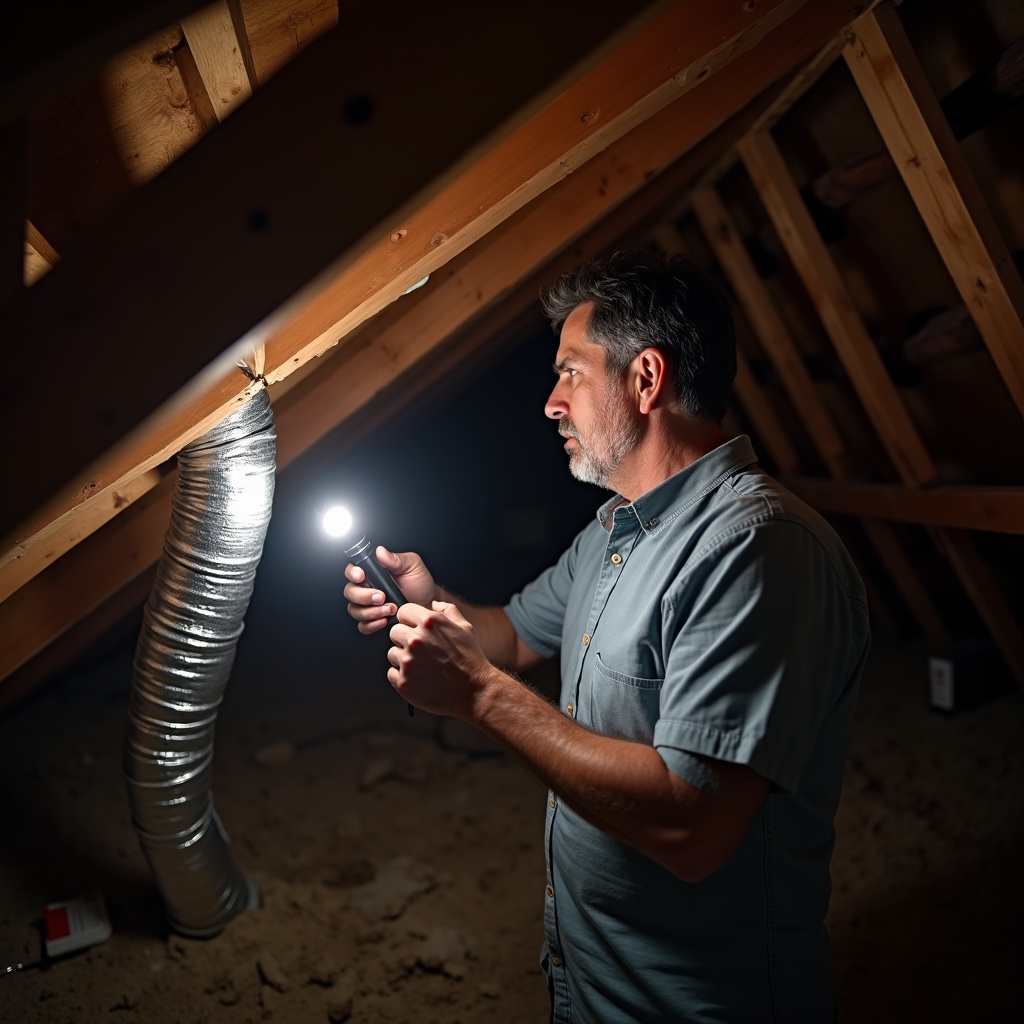
If you can safely access your attic, crawlspace, or basement, inspect visible ductwork for obvious problems. Bring a flashlight and look for disconnected sections, gaps at joints, crushed or kinked flex duct, and deteriorated insulation wrapping. Round ducts made entirely from formed fiberglass tend to have a lot of leakage at all connection points, and as the fiberglass is exposed to the airstream, it finds its way into the home when it deteriorates.
Pay particular attention to connection points where ducts meet the air handler, branch takeoffs, and boot connections at registers. These joints represent the most common leak locations. Look for black streaks on duct insulation—these dirt trails indicate air escaping and pulling dust particles through the breach. Also examine areas where ducts pass through framing or turn corners; vibration and settling over decades can open gaps at these stress points.
Many homes in Plaza Buena Park feature attic-mounted air handlers with ductwork running through unconditioned attic spaces. Southern California’s extreme attic temperatures—often exceeding 140°F in summer—accelerate deterioration of duct materials, particularly older fiberglass and flex duct installed before modern standards.
Common Duct Material Problems in Older Buena Park Homes
Buena Park’s housing stock includes many homes built during periods when inferior duct materials were standard. Fiberglass ductwork shows signs of aging after 10-15 years, yet many local homes still operate with original 30-40 year old duct systems. Flexible ducts with exposed fiberglass insulation wrapped around spiral metal wire cores were extremely common in 1970s-1980s construction—and these systems are now failing at alarming rates.
During your visual inspection, watch for sagging flex duct sections that have stretched and kinked, reducing airflow. Check for tape that has dried out and separated from joints. Traditional duct tape (despite its name) degrades rapidly in attic heat and is completely ineffective for permanent duct sealing. If you see silver-gray tape at connections, assume those joints are leaking.
Step 4: Perform the Tissue Paper Test at Supply Vents
This simple DIY test reveals whether your supply vents are delivering adequate airflow. Turn your system to cooling mode and set the thermostat low enough to trigger continuous operation. Hold a tissue or single sheet of toilet paper near each supply vent. Strong, consistent airflow should hold the paper firmly against the vent opening.
Weak airflow that barely moves the tissue indicates either blockage or—more commonly—duct leaks upstream siphoning air before it reaches the vent. Test every supply register in your home and note which rooms show weak performance. These problem areas help a qualified HVAC services in Buena Park technician target inspection efforts.
Also listen carefully at each vent. Hissing or whistling sounds indicate air forcing through small openings—often gaps where the supply boot connects to the register. Remove the register cover and inspect the boot connection with a flashlight. Gaps around the boot perimeter are extremely common and easily sealed by a professional using proper mastic sealant.
Step 5: Check for Excessive Dust Accumulation
Leaky return ducts pull unconditioned air from attics, crawlspaces, and wall cavities—spaces filled with dust, insulation particles, and allergens. If you’re constantly battling dust despite regular cleaning, your return ductwork likely has significant leaks drawing contaminated air into your living spaces.
Inspect return air grilles for dust buildup patterns. Heavy accumulation on the grille face indicates air being drawn through leaks rather than the intended pathways. Also check around the return air filter—if you see dust bypassing the filter and coating the inside of the return air housing, your system is pulling unfiltered air through leaks.
Excessive dust isn’t just a nuisance—it’s a clear indicator that your duct system is compromised and impacting Indoor Air Quality in Buena Park homes. For families with allergies or asthma, leaky return ducts can trigger symptoms by constantly circulating attic dust and insulation fibers throughout living spaces.
The Connection Between Duct Leaks and Air Quality
Gaps and leaks may allow dust, insulation particles, or attic debris to enter the air stream, and over time, this can contribute to increased dust buildup in the home and reduced air cleanliness. In Buena Park’s older neighborhoods, homes with original ductwork often have return leaks in attics where fiberglass insulation has degraded over decades, releasing particles directly into the air your family breathes.
Step 6: Listen for Unusual System Noises
Turn off televisions, radios, and other noise sources, then stand near your air handler while the system operates. Listen for whistling, hissing, or rattling sounds coming from ductwork. These noises indicate air escaping through gaps or loose connections vibrating during operation.
Walk through your home while the system runs and listen near supply and return vents. Hissing at vents signals leaks at boot connections. Rattling suggests loose duct sections that have separated slightly, creating gaps. Whistling often indicates air forcing through small holes or gaps in duct seams.
Pay attention to how your system sounds compared to a year or two ago. Ductwork deterioration is gradual—joints that were tight when your system was newer may have separated over time due to vibration, temperature cycling, and building settlement. Increasing noise levels almost always correlate with developing or worsening duct leaks.
Step 7: Schedule Professional Duct Pressure Testing
While DIY inspections reveal obvious problems, professional duct testing quantifies exactly how much air your system is losing. A duct blaster test pressurizes your duct system to a standard 25 Pascals and measures airflow required to maintain that pressure. The test produces a precise leakage percentage that guides repair decisions.
A reputable hvac contractor in Buena Park will seal all supply registers, attach a calibrated fan to your duct system, and pressurize the ducts while measuring airflow. If an HVAC system is designed to move 1000 cubic feet per minute (CFM) of air, and 100 CFM is lost due to leakage, the duct leakage percentage is 10%. Modern building standards require duct leakage below 6% for new construction, but many older Buena Park homes test at 20-30% leakage or higher.
The test also identifies whether leaks are on the supply side (wasting conditioned air) or return side (pulling in unconditioned air and contaminants). Supply-side leaks in attics are particularly costly because they dump expensive cooled air directly into 140°F+ attic spaces. Return-side leaks in attics pull superheated air into your system, forcing your AC to work much harder.
Understanding Your Duct Test Results
After testing, ask your hvac company in Buena Park for a detailed report showing total CFM leakage, leakage percentage, and whether leaks are primarily supply-side or return-side. Leakage above 15% typically justifies professional sealing. Leaks, gaps, and deteriorated insulation allow conditioned air to escape into attics, crawlspaces, or basements, reducing system efficiency by as much as 20–40%.
Request documentation of which duct sections showed the highest leakage rates. This information helps prioritize repairs if budget constraints prevent addressing all leaks immediately. Sealing the worst offenders first delivers the greatest comfort and efficiency improvements per dollar spent.
Step 8: Evaluate Repair vs. Replacement Options
Once you’ve identified duct leakage, decide between sealing existing ducts or full replacement. The choice depends on duct age, material type, accessibility, and leak severity. For homes with ductwork less than 20 years old showing moderate leakage (10-20%), professional sealing typically makes financial sense. Air duct sealing costs $1 to $2 per square foot or $1,000 to $6,000 total, depending on home size and duct accessibility.
Two primary sealing methods exist: manual sealing using mastic paste and metal-backed tape, or aerosol sealing (Aeroseal) that sprays sealant particles into the duct system from inside. Manual duct sealing costs $2,250 on average, while aerosol sealing costs $1,300. Aeroseal reaches inaccessible leaks behind walls and in tight spaces that manual sealing cannot address, making it highly effective for homes where ductwork is largely hidden.
For homes with ductwork older than 25-30 years, particularly systems using deteriorated fiberglass duct or failing flex duct, replacement often proves more cost-effective long-term. Modern duct materials with properly sealed connections can reduce leakage to below 6%, dramatically improving comfort and cutting energy waste. When replacing Ac Repair in Buena Park systems or Furnace Repair in Buena Park equipment, consider whether duct replacement should be bundled—installing new HVAC equipment on failing ductwork wastes the efficiency potential of modern systems.
| Factor | Duct Sealing | Duct Replacement |
|---|---|---|
| Best For | Ducts under 20 years old with moderate leaks | Ducts over 25 years old or severely deteriorated |
| Typical Cost | $1,200–$2,500 | $3,500–$8,000+ |
| Energy Savings | 15–25% reduction in waste | 25–40% reduction in waste |
| Project Duration | 4–8 hours | 1–3 days |
| Disruption Level | Minimal—mostly attic work | Moderate—may require ceiling access |
Calculating Your Potential Savings
To estimate annual savings from duct sealing, calculate 20-30% of your current annual heating and cooling costs—that’s approximately how much leaky ducts are costing you. For a Buena Park home spending $2,400 annually on HVAC energy, duct leaks waste roughly $480-$720 per year. Professional sealing pays for itself in 2-4 years through reduced energy bills, plus you gain immediate comfort improvements.
California utility companies and local programs occasionally offer rebates for duct sealing and testing. Check the Database of State Incentives for Renewables and Efficiency (DSIRE) for current programs serving Buena Park residents. Some programs cover up to $400 toward professional duct testing and sealing, significantly reducing out-of-pocket costs.
Take Action Before Peak Season Hits
Leaky ducts don’t fix themselves—they worsen gradually as materials age and connections loosen. Every month you delay addressing duct leakage, you’re literally paying to heat or cool your attic instead of your living spaces. The eight steps outlined in this guide give you a clear roadmap from initial detection through professional diagnosis and repair decision-making.
If you’ve identified any warning signs—rising energy bills, uneven temperatures, excessive dust, or weak airflow—don’t wait until summer heat or winter cold arrives to address them. Schedule a professional duct inspection during mild weather when HVAC companies have greater availability and you’re not desperate for immediate comfort.
Ready to stop wasting money and reclaim your home’s comfort? Call Shalom Heating & Air at (714) 886-2021 to schedule a comprehensive duct inspection and leakage test. Our experienced technicians serve Buena Park homeowners with honest assessments and practical solutions tailored to your home’s specific needs and your budget. We’ll show you exactly where your conditioned air is escaping and provide clear options for fixing the problem permanently.
