
Top Central AC Brands for Manhattan Beach: 2026 Guide
Why Choosing the Wrong Central AC Brand Costs Manhattan Beach Homeowners Thousands
When a family in the Kevyn Avenue Area replaced their standard central air conditioner last August, they thought they’d saved money by choosing the cheapest available unit. Within eighteen months, the coastal salt air had corroded the aluminum fins beyond repair, the compressor leaked refrigerant three times, and the replacement cost exceeded what they would have paid for a corrosion-resistant model from the start. That story repeats across Manhattan Beach every cooling season—homeowners underestimate how aggressively this coastal microclimate destroys AC systems that weren’t designed for it.
📋 In This Guide
Manhattan Beach’s unique combination of temperatures typically ranging from 50°F to 74°F with persistent ocean breezes carrying salt particles up to two miles inland creates a perfect storm for HVAC equipment failure. The air you breathe near HVAC services in Manhattan Beach contains corrosive particles that standard central air conditioner brands simply weren’t engineered to handle. When you factor in California’s minimum SEER2 rating requirement of 14.3 for split-system air conditioners, the decision becomes even more complex. This guide breaks down which brands actually survive Manhattan Beach conditions, what features matter most in ZIP code 90266, and how to avoid the expensive mistakes that plague coastal homeowners who treat their AC purchase like an inland decision.
How Manhattan Beach’s Coastal Environment Destroys Standard Central Air Units Faster
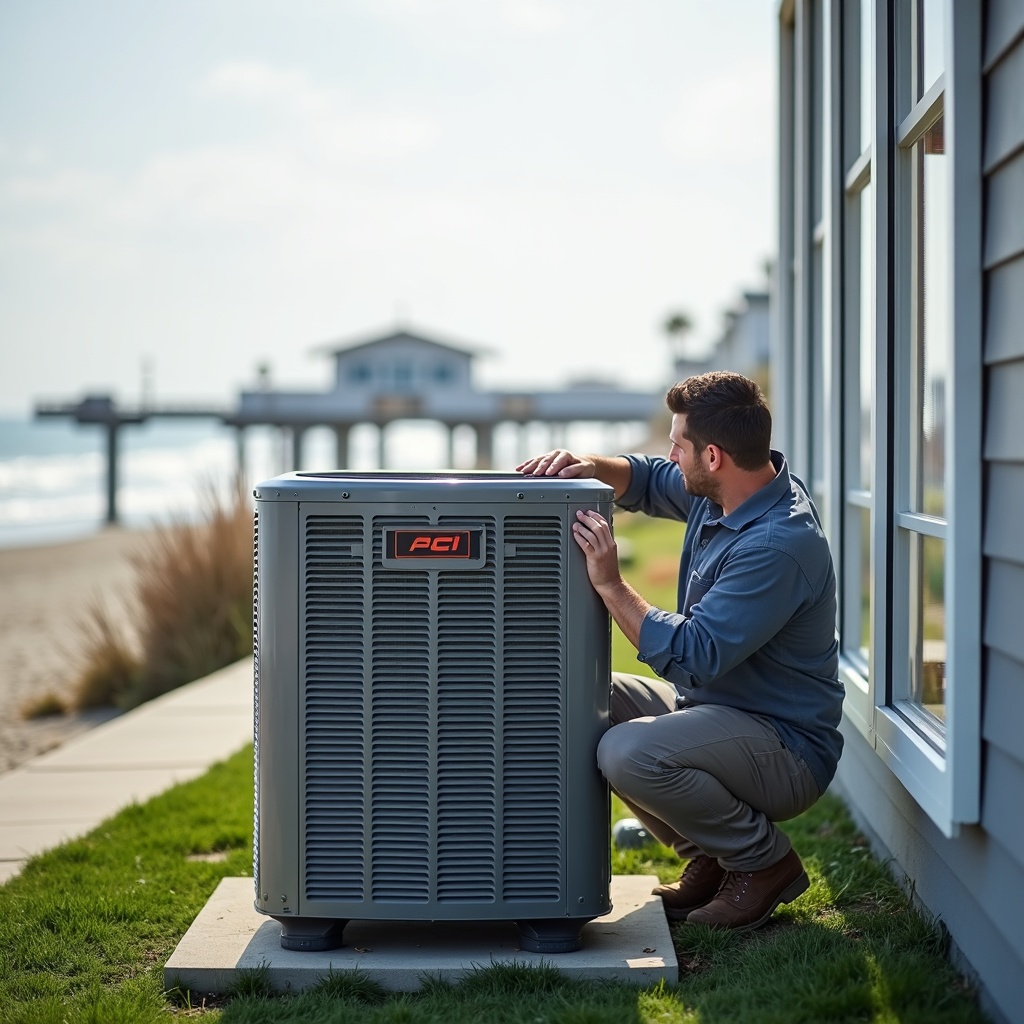
The ocean breeze that makes living near The Strand so pleasant becomes your AC system’s worst enemy the moment it’s installed. Coastal air carries high levels of salt particles, and salt water can be carried as far away as two miles from the coast. When those particles settle on your outdoor condenser unit, they don’t just sit there—they actively attack metal components.
Once salt mixes with humidity, it begins to break down protective metal surfaces and speeds up the corrosion process, creating an environment where HVAC equipment ages faster compared to systems located inland. The aluminum fins that transfer heat start deteriorating within months on units without proper coastal protection. Copper coils develop pinhole leaks. Even the cabinet screws rust through, compromising structural integrity.
What makes Manhattan Beach particularly challenging is the year-round exposure. Unlike inland areas where AC systems rest during cooler months, the summers are comfortable, arid, and clear and the winters are long, cool, wet, and partly cloudy, meaning your condenser unit never gets a break from salt exposure. An hvac contractor in Manhattan Beach who understands these local conditions will immediately steer you away from standard models that work fine ten miles inland but fail catastrophically near the coast. The typical lifespan of a central air conditioner in most climates is 15-20 years, but regular AC units exposed to salt air can fail within 5 years, while salt-resistant models can last 10-15 years.
Understanding SEER2 Requirements and Efficiency Standards for Manhattan Beach in 2026
The efficiency landscape changed dramatically in 2023 when the Department of Energy implemented new testing standards. For Californians, minimum SEER2 ratings have risen from the SEER rating of 14 to 14.3, and given the higher performance requirements of the enhanced M1 test, this 14.3 rating is actually the equivalent of a SEER 15 rating. That shift matters because manufacturers had to redesign equipment to meet stricter real-world testing conditions.
For Manhattan Beach homeowners, the SEER2 question isn’t just about meeting minimum legal requirements—it’s about balancing upfront cost against long-term operating expenses in a climate that runs AC systems approximately 6-8 months yearly. A good SEER2 rating depends on the region, but generally, a rating of 15.2 SEER2 or higher is considered high efficiency, with minimum SEER2 ratings for new air conditioners approximately 14.3 SEER2 in southern states.
The practical reality: a 16 SEER2 system will consume roughly 12% less energy than the 14.3 minimum. In Manhattan Beach’s moderate climate, that translates to $150-250 in annual savings for a typical 2,000 square foot home. Over fifteen years, you’re looking at $2,250-3,750 in reduced electricity costs—enough to justify the $800-1,200 upfront premium for mid-tier efficiency. But jumping from 16 SEER2 to 20+ SEER2 adds $2,000-3,500 to equipment costs, and the payback period extends beyond ten years unless you’re running the system heavily or electricity rates spike.
One often-overlooked factor: higher-efficiency units typically feature variable-speed compressors and better humidity control, which matters tremendously in Manhattan Beach’s marine layer mornings. Those features improve comfort beyond what the SEER2 number alone suggests. If you’re exploring AC repair in Manhattan Beach and your existing system is struggling with humidity, upgrading to a higher-efficiency model solves multiple problems simultaneously.
Carrier: Coastal Protection Engineering That Actually Works in Salt Air
Prior to 2023, Carrier coastal air conditioner and heat pump models used a copper tube and aluminum fins, but to avoid galvanic corrosion between these two metals, Carrier transitioned all coastal models to its patented welded aluminum coil technology. That engineering decision makes Carrier’s coastal-designated models legitimately different from their standard lineup—not just marketing.
The Infinity series represents Carrier’s premium tier, with the Carrier Infinity® 26 Air Conditioner with Greenspeed® Intelligence offering up to 24 SEER2. For Manhattan Beach applications, the Infinity 24 Coastal model strikes the better value proposition—19 SEER2 efficiency with full marine-environment protection at roughly $2,000 less than the flagship Infinity 26. Welded aluminum benefits include zinc cladding layer applied for improved corrosion resistance and up to 81% better projected lifespan vs. copper coil.
Installed costs for Carrier systems in Manhattan Beach typically run $7,500-$11,500 for a complete 3-ton system, depending on efficiency tier and whether ductwork modifications are needed. The Comfort series (14.3-16 SEER2) starts around $7,500 installed, Performance series (17-18 SEER2) runs $8,500-$9,800, and Infinity coastal models (19-24 SEER2) command $10,200-$13,500.
Carrier’s ten-year parts warranty extends to all components when registered within 90 days of installation. The compressor coverage is particularly important in coastal environments where system stress runs higher. One advantage: Carrier maintains the largest authorized dealer network in Los Angeles County, making warranty service and replacement parts readily available when you need them.
| Brand | SEER2 Range | Coastal Protection | Installed Cost (3-ton) | Warranty |
|---|---|---|---|---|
| Carrier | 14.3–24 | Welded aluminum coils | $7,500–$13,500 | 10 years parts |
| Trane | 13.4–22 | Spine Fin aluminum coil | $8,000–$14,200 | 10 years parts |
| Lennox | 14.3–28 | Quantum Coil with WeatherArmor | $8,200–$15,800 | 10 years parts |
| Rheem | 14.3–20 | Standard coil with coating | $6,800–$10,500 | 10 years parts |
| Goodman | 14.3–17 | Standard (coastal coating recommended) | $5,800–$8,500 | 10 years parts |
| American Standard | 13.4–22 | Spine Fin aluminum coil | $7,800–$13,800 | 10 years parts |
| Daikin | 15–21 | Inverter technology, standard coil | $7,200–$11,800 | 12 years parts |
Trane: Maximum Durability When You Plan to Stay Long-Term Near The Strand
Trane built its reputation on equipment that simply refuses to die, even under punishing conditions. Aluminum performs much better against saltwater corrosion, and Trane has an exclusive method of transferring the aluminum tubing to copper at the ends of its rope-like coil design. That Spine Fin coil technology appears across Trane’s entire residential lineup, giving even their entry-level models better coastal resistance than many competitors’ mid-tier units.
The field test results speak louder than marketing materials: After seven years of being exposed to the elements, the Trane coil is still withstanding saltwater corrosion better than both of the other brands in a direct comparison test. For Manhattan Beach homeowners planning to stay in their homes 10+ years, that durability advantage compounds dramatically.
A Trane air conditioner costs $5,000 to $25,000 installed on average, depending on the model, size, and SEER rating, with Trane’s popular XR14 AC unit costing $8,800 to $13,600, while their high-efficiency XL17i costs $17,200 to $26,000. For Manhattan Beach applications, the sweet spot sits with the XR16 (up to 17.2 SEER2) at $9,200-$11,800 installed for a 3-ton system, or the XL18i (up to 19.5 SEER2) at $11,500-$14,200.
Trane’s ComfortLink II communicating technology deserves special mention for coastal installations. The system monitors humidity levels continuously and adjusts compressor speed to maintain optimal indoor conditions—critical during Manhattan Beach’s marine layer mornings when outdoor humidity spikes but temperatures remain moderate. Standard single-stage systems cycle on and off repeatedly in these conditions, wearing components faster and providing inconsistent comfort.
Noise levels matter when your outdoor unit sits fifteen feet from a bedroom window in dense Manhattan Village neighborhoods. Offering up to 14.8 SEER2, the XR14 delivers solid energy efficiency for moderate climates, while its Climatuff® compressor ensures long-lasting performance, built with Trane’s signature durability, including a corrosion-resistant Spine Fin™ coil and a powder-coated steel cabinet for added protection against the elements. Variable-speed models run as quietly as 51 decibels at low capacity—quieter than normal conversation.
Why Trane Commands Premium Pricing in Manhattan Beach
Trane is the top AC brand for 2023 followed by Lennox and Carrier close behind – this is according to data compiled from consumers and AC technicians that work on all the brands. That reputation translates directly to resale value. Real estate agents in Manhattan Beach consistently report that disclosed HVAC brands influence buyer perception, with Trane installations adding measurable appeal during home sales.
The ten-year limited warranty covers all functional parts, but Trane dealers typically offer extended labor coverage options that competitors don’t match. Given that labor costs for coastal repairs run $150-$225 per hour in this market, a $400 extended labor warranty pays for itself with a single compressor replacement.
Lennox: Maximum Efficiency at Premium Prices for Energy-Conscious Homeowners
Lennox’s top air conditioner model is the SL28XCV, part of the Dave Lennox Signature® Collection, achieving an industry-leading efficiency rating of up to 28 SEER. That number isn’t a typo—it’s nearly double California’s minimum requirement and represents the absolute pinnacle of residential AC efficiency available in 2026.
But let’s address the practical question: does 28 SEER make sense for Manhattan Beach’s moderate climate? The honest answer is usually no, unless electricity costs are your absolute priority or you’re pursuing net-zero energy targets. The $6,000-$8,000 premium over a 16 SEER2 system requires decades to recover through energy savings in this temperature range. The Lennox XC20 (up to 20.5 SEER2) or EL17XC1 (up to 18.3 SEER2) deliver 90% of the efficiency benefit at 40-50% lower cost.
What makes Lennox particularly attractive for Manhattan Beach installations is the SilentComfort technology combined with Quantum Coil construction. Engineered for quiet operation, it features SilentComfort™ technology to minimize noise—important when outdoor units sit in compact side yards between houses. The Quantum Coil uses aluminum construction with enhanced corrosion resistance, though it doesn’t match Trane’s Spine Fin or Carrier’s welded aluminum in long-term salt-air testing.
Installed pricing for Lennox systems in Manhattan Beach ranges $8,200-$15,800 for complete 3-ton installations. The Merit series (14.3-16 SEER2) starts around $8,200, Elite series (17-21 SEER2) runs $10,500-$13,200, and Dave Lennox Signature Collection (23-28 SEER) commands $14,500-$18,500. Lennox dealers typically include higher-quality thermostats in base pricing, which adds $300-$500 in value versus competitors who charge separately for premium controls.
iComfort S30 Smart Thermostat Integration
Lennox’s proprietary controls offer features that independent thermostats can’t replicate when paired with compatible systems. The Indoor Air Quality in Manhattan Beach component of the iComfort S30 monitors temperature and humidity in multiple zones, adjusting system operation to maintain precise comfort levels rather than just hitting temperature setpoints. During shoulder seasons when Manhattan Beach temperatures hover in the comfortable range but humidity varies wildly, this granular control prevents the clammy indoor conditions that plague simple thermostat systems.
Rheem, Goodman, and American Standard: Value Tiers for Different Budget Levels
Not every Manhattan Beach homeowner needs or wants flagship equipment. These three brands occupy distinct value positions that make sense for specific situations.
Rheem: Mid-Tier Performance Without Premium Pricing
Rheem delivers solid reliability at price points $1,000-$2,000 below Carrier/Trane equivalents. Rheem, Daikin, and Amana offer a balance of performance, warranty protection, and overall value. The RA17 series (up to 17.2 SEER2) provides two-stage cooling with decent humidity control for $7,800-$9,500 installed—competitive with Trane’s entry-level XR series but $1,200 less on average.
The tradeoff: Rheem’s standard coils use conventional construction without specialized coastal protection. For properties more than one mile from the ocean (eastern portions of Manhattan Beach), that’s acceptable. Within a half-mile of the coast, plan on adding aftermarket corrosion coating ($400-$650) or accepting 12-year lifespan instead of 15-18 years. Ten-year parts warranty matches premium brands, but dealer network density runs thinner—you’ll have fewer contractor options for service.
Goodman: Budget-Friendly Option With Compromises
Goodman and York often appeal to homeowners seeking more budget-friendly systems. Goodman’s GSXC18 (up to 18.5 SEER2) costs $6,200-$7,800 installed for 3-ton capacity—the lowest pricing you’ll find for two-stage cooling from a nationally-recognized brand.
What you’re sacrificing: noisier operation (70-76 decibels versus 55-65 for premium brands), basic controls, and standard coil construction that won’t survive coastal conditions without added protection. Goodman makes sense for investment properties, short-term ownership (under 7 years), or inland locations where salt exposure runs minimal. For primary residences near The Strand or Manhattan Beach Pier, the $2,000 savings typically proves false economy when the unit fails years earlier than coastal-rated alternatives.
American Standard: Trane Engineering at Slightly Lower Cost
American Standard shares parent company ownership with Trane and uses identical Spine Fin coil technology across comparable models. American Standard offers well-built, mid-range systems known for quiet operation and reliable cooling. The Platinum 18 (up to 18 SEER2) delivers the same coastal corrosion resistance as Trane’s XL16i at $7,800-$10,200 installed—roughly $800-$1,200 less for equivalent specifications.
The catch: dealer network runs smaller, and resale perception doesn’t match Trane’s brand recognition. For homeowners who prioritize engineering substance over nameplate, American Standard represents legitimate value. The ten-year warranty coverage matches Trane exactly, because it’s administered by the same parent company.
Daikin: Global Leader in Inverter Technology With Growing U.S. Presence
Daikin dominates global HVAC markets but remains less familiar to U.S. homeowners despite acquiring Goodman in 2012. The brand’s strength lies in inverter-driven variable-speed technology that’s been refined over decades in Asian and European markets. The DX20VC (up to 20.5 SEER2) uses true inverter compressor operation—fundamentally different from the variable-speed implementations in Carrier or Trane systems.
For Manhattan Beach applications, Daikin’s advantage emerges during partial-load operation. When outdoor temperatures sit in the 68-75°F range (common 6-8 months yearly here), the system can run at 25-40% capacity continuously rather than cycling on and off. That delivers superior humidity control and eliminates the temperature swings that make coastal homes feel clammy despite moderate temperatures. Installed costs run $8,500-$11,800 for 3-ton systems (16-20.5 SEER2 range).
The limitation: dealer network density in South Bay lags behind Carrier/Trane. You’ll find quality contractors, but fewer options for competitive bidding. Twelve-year parts warranty exceeds most competitors by two years, offering some offset to dealer availability concerns. Daikin’s standard coils use conventional construction, so coastal installations benefit from aftermarket corrosion protection added during installation.
Installation Considerations Specific to Manhattan Beach Homes
Equipment selection represents only half the equation—installation quality determines whether your system achieves its rated lifespan and efficiency. Manhattan Beach presents specific challenges that generic HVAC contractors often miss.
Rooftop versus ground-level placement: Many Manhattan Beach homes feature rooftop condensers to preserve limited yard space. Salt exposure actually runs lower at roof level (particles settle rather than rising), but summer roof temperatures add 15-25°F to ambient conditions, forcing the compressor to work harder. Right-sizing becomes critical—oversized units short-cycle even worse in this scenario. AC Installation in Manhattan Beach: 8 Steps to Success covers the complete process.
Drainage and moisture management: Salt particles settle on your AC unit’s surfaces, and combined with humidity, this creates the perfect environment for corrosion. Proper drainage prevents standing water around the base. Local contractors who understand coastal installations add drainage improvements that generic installers omit.
Electrical considerations: Trane implemented up to a 5% price increase on residential HVAC products effective January 1, 2026, following a pattern of annual adjustments across the industry, driven by rising material costs, freight expenses, labor rates, and the ongoing refrigerant transition from R-410A to lower-GWP alternatives like R-454B. New systems using A2L refrigerants require updated electrical disconnects and leak detection—code requirements that add $350-$550 to installation costs.
Ductwork assessment: A new AC unit costs $3,300 to $5,900 on average, depending on the type, size, and condition of ductwork. Many Manhattan Beach homes built before 1990 have undersized or leaky ductwork that sabotages even premium equipment. Proper load calculation and duct evaluation prevent the expensive mistake of installing a $12,000 system that can’t perform because distribution infrastructure fails.
When to Replace Your Manhattan Beach Central Air Conditioner
The decision timeline differs from inland locations because coastal corrosion accelerates failure modes. Use the $5,000 rule for AC repair/replace decisions: If (age × repair cost) > $5,000, replacement usually makes more sense. For a 12-year-old system needing a $600 compressor replacement, that calculation yields $7,200—well above the $5,000 threshold.
But Manhattan Beach adds another factor: remaining corrosion resistance. Even if your 14-year-old unit still runs, inspect the condenser coils carefully. If you see significant fin deterioration or cabinet rust-through, replacement makes sense before catastrophic failure. Emergency replacements in peak summer cost 15-25% more than planned installations during shoulder seasons due to contractor availability and reduced negotiating leverage.
Spring (March-May) represents optimal replacement timing for Manhattan Beach. Contractors offer better availability, manufacturers run promotional financing, and you’re replacing before summer demand spikes pricing. If your system is 12+ years old, showing declining efficiency (electricity bills creeping up 15%+ versus previous years), or requiring frequent repairs, schedule evaluation now rather than waiting for July failure.
For expert assessment of your current system and guidance on the best replacement options for your specific location and budget, contact Shalom Heating & Air for a detailed evaluation.
❓ Frequently Asked Questions
How long does a central air conditioner last in Manhattan Beach's salt air?
Standard AC units without coastal protection typically fail within 5-8 years in Manhattan Beach due to salt corrosion. Coastal-rated models from Carrier, Trane, or Lennox with corrosion-resistant coils can last 12-15 years with proper maintenance. Distance from the ocean matters—units within a half-mile of the coast face the most aggressive conditions.
What SEER2 rating should I choose for Manhattan Beach climate?
California requires minimum 14.3 SEER2, but 16-18 SEER2 offers the best value for Manhattan Beach's moderate climate. The efficiency savings justify the $800-1,200 upfront premium, delivering $150-250 annual electricity savings. Systems above 20 SEER2 rarely provide cost-effective payback in this temperate coastal environment unless you're targeting net-zero energy consumption.
Can I use a standard central AC unit if I live inland from the beach?
Salt air reaches up to two miles inland, affecting even eastern Manhattan Beach neighborhoods. Properties within one mile of the ocean absolutely need coastal-rated equipment. Beyond one mile, you can use standard units with aftermarket corrosion coating ($400-650), though coastal models still provide better long-term value given the extended lifespan in this environment.
Should I contact Shalom Heating & Air for Manhattan Beach AC installation?
Shalom Heating & Air provides expert central air conditioner installation throughout Manhattan Beach, with deep understanding of coastal corrosion challenges and proper equipment selection for salt-air environments. Their technicians perform Manual J load calculations, assess ductwork integrity, and recommend brands proven to survive local conditions—essential factors that generic contractors often overlook in coastal installations.
📖 More Tips for Manhattan Beach
-
 AC Installation in Manhattan Beach: 8 Steps to Success
When you're installing AC in Manhattan Beach, understanding each step—from load calculations to mandatory HERS testing—protects your investment.…

