
5 HVAC Summer Energy Myths Busted for Bellflower Homes
The Energy-Saving Checklist You Need Before Bellflower’s Peak Heat Hits
With California electricity rates at 36 cents per kilowatt-hour in 2026 and peak hours running from 4–9 p.m. or 5–8 p.m. depending on your Southern California Edison plan, Bellflower homeowners are paying some of the highest cooling costs in the nation. But here’s the problem: most of the “energy-saving advice” circulating among neighbors in Downtown Bellflower and Mayfair is outdated, misleading, or flat-out wrong.
📋 In This Guide
The misconceptions about how to reduce HVAC energy costs Bellflower residents face each summer can actually increase your bills rather than lower them. This myth-busting guide cuts through the noise with evidence-based strategies verified by the Department of Energy and actual cost data from Southern California. Follow this framework to lower your cooling expenses without sacrificing comfort during the brutal summer months ahead.
Myth #1: Setting Your Thermostat to 68°F Cools Your Home Faster
The Reality: Your air conditioner cools at the same rate regardless of the temperature you select. Setting your thermostat at a colder setting than normal when you turn on your air conditioner will not cool your home any faster and could result in excessive cooling and unnecessary expense. What actually happens is your system runs longer—often cooling your home 10–15 degrees below a comfortable level—which wastes hundreds of dollars over a summer season.
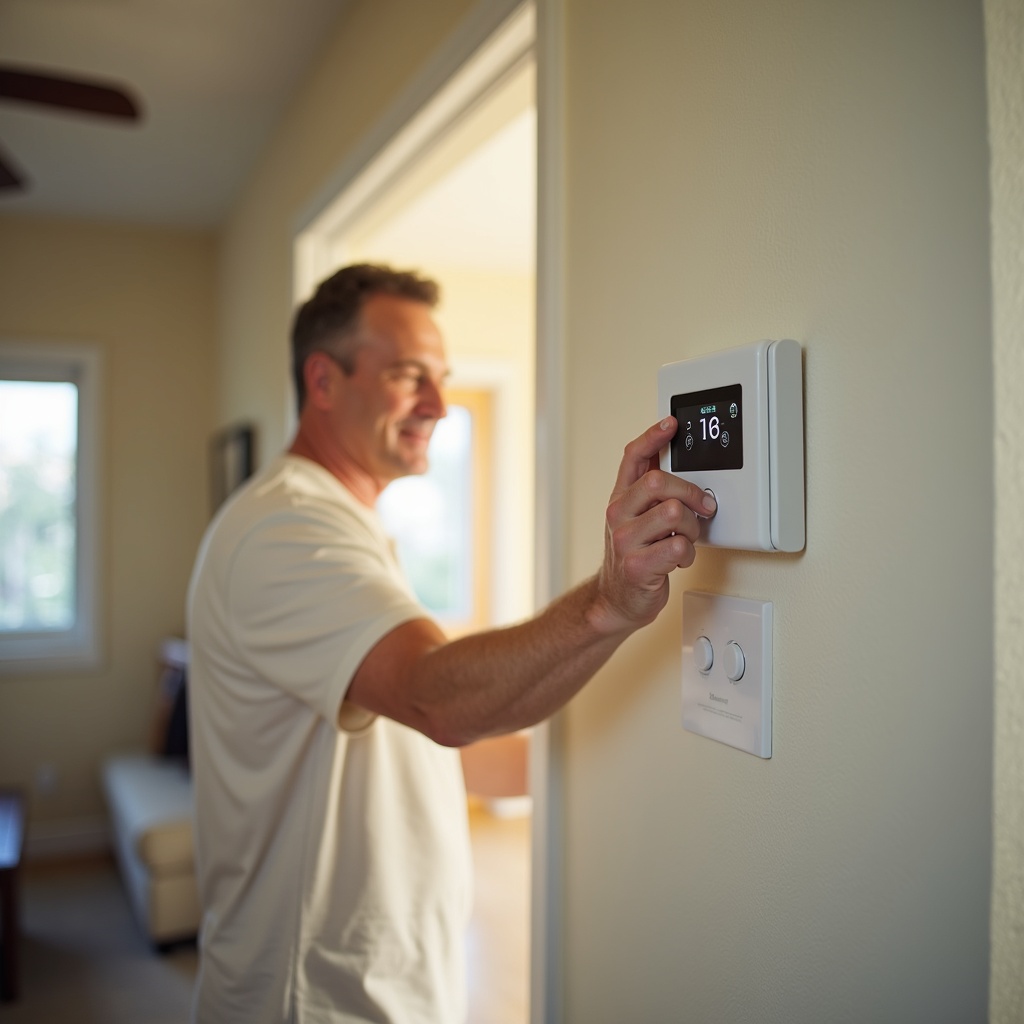
When you arrive home to a warm house in Somerset or near Thompson Park, resist the urge to crank the thermostat down. Instead, set it to your target temperature (78°F is optimal according to the Department of Energy) and let the system work at its designed pace. If you need faster relief, turn on ceiling fans to create air movement that makes the space feel cooler immediately.
Action Step for Your Checklist
Program your thermostat to 78°F when home and awake, 85°F when away for more than 4 hours. You can save as much as 10% a year on heating and cooling by simply turning your thermostat back 7°–10°F for 8 hours a day from its normal setting. For a typical Bellflower household spending $200–$300 monthly on summer cooling, that’s $20–$30 in monthly savings or $240–$360 annually.
Myth #2: Closing Vents in Unused Rooms Saves Energy
The Reality: Your central HVAC system is designed to distribute air throughout your entire home based on a calculated load. When you close vents in guest bedrooms or storage areas, you don’t reduce the amount of air your system produces—you increase pressure in the ductwork, force air through leaks in other areas, and make your blower motor work harder. The result is often higher energy consumption and potential damage to your system.
This is especially problematic in Bellflower’s older housing stock where ductwork may already have minor leaks. Increased pressure turns small gaps into major efficiency drains. A professional Ac Repair in Bellflower service can assess whether your duct system is properly balanced and sealed.
Action Step for Your Checklist
Keep all vents open and unobstructed by furniture or curtains. If certain rooms consistently feel too cold while others are too warm, you likely have a duct balancing issue or air sealing problem—not a vent closure solution. Contact a qualified hvac contractor in Bellflower to perform a duct inspection and seal any leaks, which can improve efficiency by 15–20%.
Myth #3: Ceiling Fans Cool Rooms When You’re Not There
The Reality: Ceiling fans don’t lower air temperature—they create a wind-chill effect on your skin that makes you feel cooler. Fans create a wind-chill effect that makes the air feel up to 4 degrees cooler on your skin, which means if your thermostat is set to 78°F, it can feel more like 74°F when the fan is running. Running fans in empty rooms wastes electricity without any benefit.
Here’s the smart strategy: Use ceiling fans only in occupied rooms, and raise your thermostat by 3–4 degrees to compensate. The fan uses roughly 90% less energy than your air conditioner to create that cooling sensation, but only if someone is there to feel it.
Action Step for Your Checklist
Install a simple reminder near your light switches: “Fans cool people, not rooms.” Turn fans off when you leave a space. If you forget frequently, consider upgrading to occupancy-sensor switches for fan control in bedrooms and living areas. Also verify your ceiling fans rotate counterclockwise in summer to push air downward.
| Strategy | Energy Impact | Annual Savings |
|---|---|---|
| Thermostat raised to 78°F | 3% per degree above 72°F | $180–$270 |
| Programmable/smart thermostat | 10% reduction | $240–$360 |
| Sealing air leaks & adding insulation | 15–30% reduction | $360–$720 |
| Regular filter changes (monthly) | 5–15% efficiency gain | $120–$360 |
| Time-of-use rate optimization | 20–30% on peak usage | $200–$450 |
Myth #4: Your Air Conditioner Doesn’t Need Maintenance If It’s Still Running
The Reality: A dirty evaporator coil, low refrigerant charge, or worn blower motor can reduce your system’s efficiency by 25–40% while the unit continues to operate. You won’t notice the problem until you see your electricity bill or experience a complete breakdown during a 95°F afternoon.
Annual maintenance catches these issues before they cost you hundreds in wasted energy. A dirty air filter alone can increase energy consumption by 5–15%. Refrigerant leaks force your compressor to run longer cycles. Blocked condenser coils prevent heat rejection, making your system work twice as hard to achieve the same cooling. For budget-conscious Bellflower families where the median household income is $72,000, these efficiency losses add up fast.
Action Step for Your Checklist
Replace your air filter every 30 days during cooling season—mark it on your calendar. Schedule professional maintenance every spring with a reputable hvac company in Bellflower. A tune-up typically costs $89–$149 but can save $200–$400 in reduced energy costs and prevent emergency repairs that cost $300–$800. Learn more about protecting your system at Indoor Air Quality in Bellflower.
Myth #5: Time-of-Use Rates Don’t Apply to Your Cooling Strategy
The Reality: All three major IOUs default customers to TOU rate plans where electricity costs 2–3x more during peak hours (typically 4–9 PM). If you’re running your air conditioner at 5 p.m. when rates spike, you’re paying premium prices for electricity when simple scheduling changes could slash those costs.
The strategy Bellflower residents should use: pre-cool your home during off-peak morning hours when electricity costs 23–28 cents per kWh instead of 45–74 cents during peak periods. Lower your thermostat to 75°F from 10 a.m. to 3 p.m., then raise it to 80°F during the 4–9 p.m. peak window. Your home’s thermal mass will maintain comfortable temperatures through the expensive evening hours without running the AC constantly.
Action Step for Your Checklist
Log into your Southern California Edison account and verify which time-of-use plan you’re on. Set your programmable thermostat to pre-cool before 4 p.m. and coast through peak hours. Close blinds on west-facing windows by 2 p.m. to block afternoon sun. This strategy alone can reduce peak-hour usage by 30–40%, saving $15–$25 per month during summer or $120–$200 over the cooling season.
Professional Help Maximizes Your Savings
While these myth-busting strategies deliver immediate results, the biggest energy drains often hide in places homeowners can’t easily access: leaking ductwork in attics, undersized return air systems, improperly charged refrigerant, or aging equipment operating at 50% efficiency. Professional HVAC services in Bellflower can identify and fix these problems.
If your summer cooling bills consistently exceed $250–$300 despite following this checklist, your system may need repairs or replacement. A 15-year-old air conditioner with a 10 SEER rating costs nearly twice as much to operate as a modern 16+ SEER model. The investment in a high-efficiency system pays for itself through energy savings, especially with current utility rebates available for qualifying equipment.
Shalom Heating & Air helps Bellflower homeowners in Downtown, Mayfair, and Somerset reduce summer cooling costs through expert diagnostics, system tune-ups, and energy-efficient upgrades. Call (714) 886-2021 today to schedule a comprehensive energy assessment and find out where your dollars are disappearing—and how to keep them in your wallet instead.
