
Budgeting Your Home Cooling Upgrade: Real AC Installation Costs for 2026 in Los Angeles
Understanding the True Cost of Air Conditioning Installation in Los Angeles
📋 In This Guide
- ▸Central Air Conditioning System Costs by Home Size
- ▸Heat Pump Installation Costs and California's Electric Future
- ▸Ductless Mini-Split System Pricing for Los Angeles Properties
- ▸Installation Labor, Permits, and California Compliance Costs
- ▸Efficiency Ratings, Utility Rebates, and Long-Term Savings
- ▸Hidden Costs and Necessary Upgrades for Los Angeles Homes
- ▸Making Smart Decisions for Your Los Angeles Home Investment
- ▸Planning Your AC Installation Investment in Los Angeles
When temperatures climb past 90 degrees in neighborhoods from Koreatown to Silver Lake, homeowners across Los Angeles start researching new air conditioning systems. But if you’ve tried to pin down actual installation costs online, you’ve likely found everything from vague price ranges to outdated estimates that don’t reflect California’s unique requirements.
The reality is that AC installation costs in Los Angeles depend on multiple factors that other regions don’t face. California’s Title 24 energy standards, local permit requirements, the diverse housing stock ranging from 1920s craftsman bungalows to modern condos, and even your property’s elevation relative to coastal breezes all influence the final price tag.
At Shalom Heating & Air, we’ve completed hundreds of installations throughout Los Angeles and surrounding communities like Glendale, Burbank, and Pasadena. We’ve seen firsthand how system selection, home characteristics, and installation complexity affect costs. This guide breaks down exactly what Los Angeles homeowners should expect to pay in 2026, without the sales pressure or inflated numbers.
Whether you’re a homeowner making a long-term investment in a high-value property (median home value: $921,200) or a landlord managing rental units, understanding these costs helps you make informed decisions and budget appropriately. Let’s walk through the numbers that matter for your Los Angeles home.
Central Air Conditioning System Costs by Home Size
Central air conditioning remains the most common choice for Los Angeles homes with existing ductwork. System costs vary primarily based on tonnage (cooling capacity), which directly correlates with your home’s square footage and specific cooling load.
For a typical 1,200-1,500 square foot home in areas like Downtown Los Angeles or Hollywood, you’ll need a 2-2.5 ton system. Equipment costs for a standard efficiency unit (14-16 SEER) range from $3,200 to $5,500. When you add professional installation, electrical work, refrigerant lines, condensate drainage, and thermostat installation, total project costs typically run $5,800 to $8,200.
Move up to a 1,800-2,200 square foot home—common in neighborhoods throughout Los Angeles—and you’re looking at a 3-3.5 ton system. Mid-efficiency equipment (16-18 SEER) costs $4,500 to $7,200, with complete installation projects ranging from $7,500 to $10,800. These larger systems require more refrigerant, larger electrical circuits, and additional labor time, which adds to the overall investment.
For spacious homes between 2,500-3,500 square feet, particularly those in hillside areas where sun exposure increases cooling loads, a 4-5 ton system becomes necessary. High-efficiency equipment (18-20+ SEER) costs $6,800 to $11,500, with total installation projects running $10,200 to $15,500. These premium systems include variable-speed compressors, advanced humidity control, and quieter operation—features that matter in densely populated Los Angeles neighborhoods.
These price ranges assume your existing ductwork is in good condition and properly sized. If modifications are needed, add $1,500 to $4,500 depending on the extent of ductwork repair or replacement. For HVAC services in Los Angeles, proper duct assessment before installation prevents future performance issues and wasted energy.
Heat Pump Installation Costs and California’s Electric Future
Heat pumps represent an increasingly popular alternative in Los Angeles, especially as California pushes toward building electrification and away from natural gas. These systems provide both cooling and heating in a single unit, which matters even in Los Angeles’ mild climate where occasional cold snaps occur.
For a 2-ton heat pump suitable for smaller homes or condos (1,200-1,500 square feet), expect equipment costs between $4,200 and $6,800. Complete installation runs $7,200 to $10,500. The higher initial cost compared to cooling-only systems is offset by eliminating the need for a separate furnace.
A 3-3.5 ton heat pump for average-sized Los Angeles homes costs $5,800 to $9,200 for equipment, with total installation projects ranging from $9,500 to $13,800. High-efficiency models with SEER ratings above 18 and HSPF (heating efficiency) ratings above 9 command premium prices but qualify for larger utility rebates.
Large 4-5 ton heat pump systems for spacious properties run $8,500 to $14,200 for equipment, with complete installations costing $13,500 to $19,800. These premium systems often include advanced features like multi-stage compressors and smart controls that optimize performance for Los Angeles’ variable climate.
Heat pumps require careful sizing for Los Angeles homes. Unlike traditional AC systems that only need to handle peak summer temperatures, heat pumps must efficiently handle both cooling loads in 95-degree weather and heating needs during winter mornings when temperatures drop to the 40s. Professional load calculations become even more critical.
If you’re converting from a traditional furnace and AC setup to a heat pump, electrical panel upgrades may be necessary. Budget an additional $1,200 to $3,500 for panel upgrades, circuit installations, and disconnect switches. Many Los Angeles homes built before 1980 have 100-amp or 125-amp electrical service that may need upgrading to support modern heat pump systems.
Ductless Mini-Split System Pricing for Los Angeles Properties
Ductless mini-split systems have gained significant traction in Los Angeles, particularly for older homes without existing ductwork, home additions, converted garages, and multi-unit properties. These systems offer zone-by-zone temperature control and exceptional efficiency, making them ideal for Los Angeles’ varied living situations.
A single-zone mini-split system (one outdoor unit, one indoor air handler) costs $2,800 to $4,500 for equipment, with complete installation running $4,200 to $6,800. These work well for studio apartments, single bedrooms, or converted spaces where running ductwork would be impractical or prohibitively expensive.
Two-zone systems (one outdoor unit, two indoor air handlers) cost $4,800 to $7,500 for equipment, with total installation ranging from $7,200 to $10,800. This configuration suits smaller homes, duplexes, or situations where you want independent temperature control for sleeping areas versus living spaces.
Three to four-zone systems run $7,200 to $11,500 for equipment, with complete installations costing $10,800 to $16,500. These multi-zone setups appeal to homeowners who want precise room-by-room control or landlords managing multi-unit properties where individual metering makes sense.
Mini-split installation costs vary significantly based on installation complexity. Wall-mounted indoor units installed on exterior walls represent the simplest scenario. Running refrigerant lines through attics, across longer distances, or mounting units on interior walls requiring longer line sets adds $400 to $1,200 per zone.
For investment property owners—relevant in Los Angeles where 64% of residents rent—mini-splits offer the advantage of separate tenant control without complex ductwork. The initial investment pays off through reduced maintenance calls and the ability to charge premium rents for units with efficient, modern cooling.
Installation Labor, Permits, and California Compliance Costs
Beyond equipment costs, labor and regulatory requirements add substantial amounts to your total investment. Understanding these components helps you evaluate contractor quotes accurately and avoid surprise expenses.
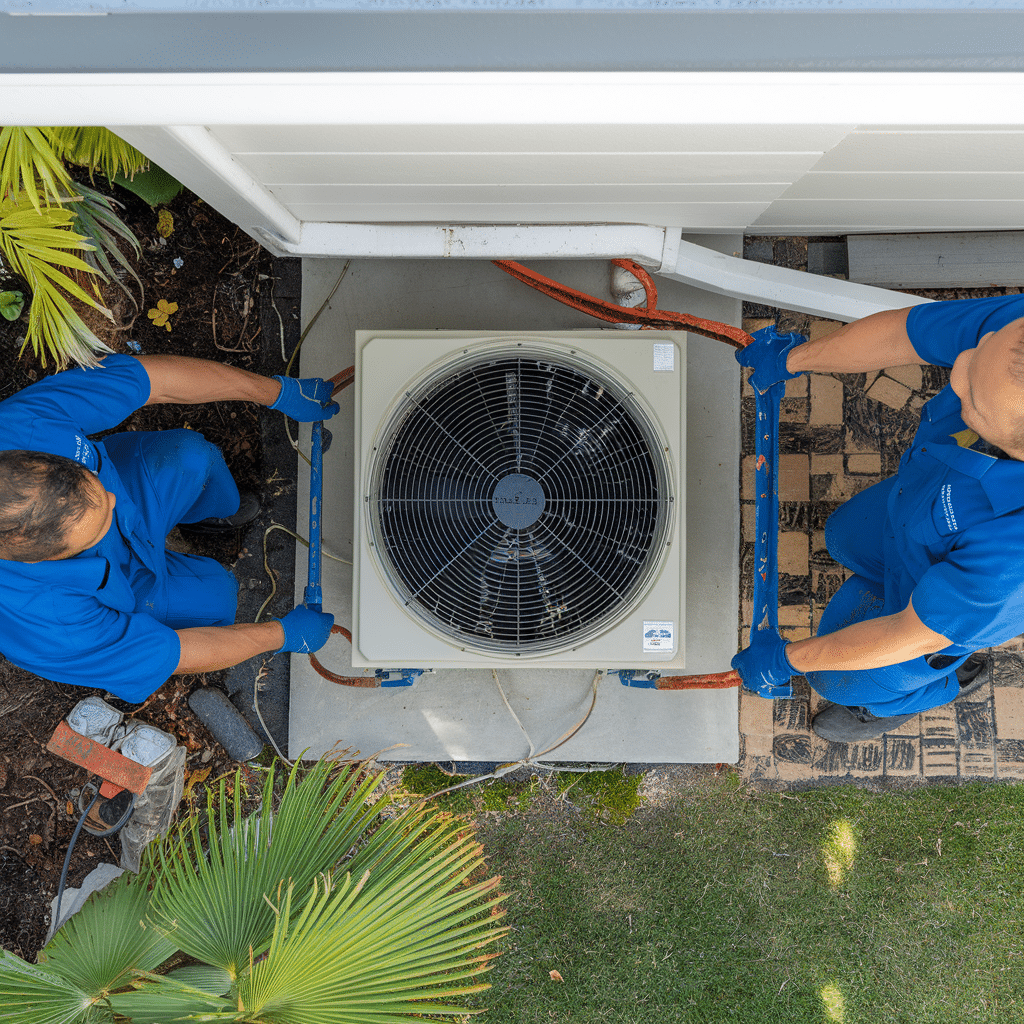
Labor costs for standard AC installation in Los Angeles typically run $2,200 to $4,500, depending on system complexity and installation challenges. A straightforward replacement where the new system matches the old one’s configuration sits at the lower end. Installations requiring refrigerant line modifications, electrical upgrades, or ductwork changes move toward the higher end.
Permit fees in Los Angeles vary by jurisdiction but typically range from $150 to $450 for residential HVAC installations. The city requires permits for any AC system replacement, and inspections verify proper installation, correct refrigerant handling, and code compliance. Working with licensed contractors ensures permit processes move smoothly and installations pass inspection on the first attempt.
California’s Title 24 building energy efficiency standards significantly impact installation costs. These regulations require specific minimum efficiency levels (currently 14 SEER or higher for most installations), proper duct sealing verified through testing, and correct refrigerant charge confirmation. Title 24 compliance documentation adds $200 to $500 to your project cost but ensures your system operates at rated efficiency.
Duct testing and sealing, mandated by Title 24, costs $400 to $900. Technicians pressurize your duct system, measure leakage rates, and seal any problematic areas. For older Los Angeles homes with original ductwork, this process often reveals significant leakage that’s been wasting energy for years. The sealing work pays for itself through improved comfort and lower utility bills.
Electrical work varies widely based on your home’s existing infrastructure. Simple disconnect switch replacement costs $150 to $300. New circuit installation from the panel to the outdoor unit runs $300 to $600. Panel upgrades for homes with insufficient capacity cost $1,200 to $3,500, depending on whether you’re upgrading from 100 to 125 amps, 125 to 200 amps, or need more extensive service entrance modifications.
For properties near landmarks like Griffith Observatory or The Getty Center where aesthetic considerations matter, additional costs may include upgraded outdoor unit screening, sound dampening installations, or placement modifications to maintain curb appeal. Budget $300 to $1,200 for these discretionary improvements.
Efficiency Ratings, Utility Rebates, and Long-Term Savings
SEER (Seasonal Energy Efficiency Ratio) ratings dramatically affect both upfront costs and operating expenses. Understanding this relationship helps Los Angeles homeowners make smart investments that balance initial price with long-term savings.
Basic efficiency systems (14-16 SEER) represent the most affordable upfront option, meeting minimum California requirements while providing reliable cooling. These single-stage systems run at full capacity whenever operating, which works adequately but costs more to operate during mild weather when full capacity isn’t necessary.
Mid-efficiency systems (16-18 SEER) add $800 to $2,200 to equipment costs but include two-stage or variable-speed compressors that adjust output to match cooling needs. In Los Angeles’ climate, where extreme heat days are interspersed with moderate temperatures, this flexibility reduces energy consumption by 15-25% compared to basic systems.
High-efficiency systems (18-20+ SEER) command premium prices—adding $2,000 to $4,500 to equipment costs—but deliver maximum comfort and minimum operating costs. Variable-speed compressors, advanced humidity control, and intelligent controls optimize performance continuously. For high-value Los Angeles homes, these systems provide comfort levels and energy savings that justify the investment.
Southern California Edison and Los Angeles Department of Water and Power offer substantial rebates for high-efficiency equipment installations. Current programs provide $300 to $1,750 in rebates depending on system efficiency and type. Heat pumps often qualify for higher rebates as utilities encourage building electrification.
Federal tax credits add another savings layer. The Inflation Reduction Act provides tax credits up to 30% of project costs (maximum $1,200 annually for AC systems, up to $2,000 for heat pumps) for qualifying high-efficiency installations. Combined with utility rebates, these incentives can offset $1,500 to $3,500 of your total investment.
For context, a homeowner upgrading from a 10 SEER system to an 18 SEER system in Los Angeles typically saves $600-900 annually on cooling costs. The efficiency premium pays for itself within 4-6 years, after which the savings flow directly to your bottom line. Over a system’s 15-20 year lifespan, this adds up to $9,000-18,000 in energy savings.
When evaluating quotes, ask contractors about convenient HVAC financing options that let you capture efficiency savings immediately rather than waiting for payback. Many financing programs structure payments so your energy savings offset or exceed the monthly payment.
Hidden Costs and Necessary Upgrades for Los Angeles Homes
Several additional expenses can surprise homeowners during AC installation projects. Being aware of these potential costs helps you budget accurately and avoid mid-project sticker shock.
Ductwork modifications represent one of the most common additional expenses. If your existing ducts are undersized, poorly routed, or damaged, proper system performance requires corrections. Minor duct modifications cost $500 to $1,500. Extensive ductwork replacement for older homes can run $3,500 to $8,500. However, addressing ductwork issues during system replacement makes sense—you’re already making a major investment, and proper ductwork ensures you get full value from your new equipment.
Thermostat upgrades add $150 to $450 for quality programmable models, or $200 to $600 for smart thermostats with WiFi connectivity, learning capabilities, and smartphone control. In Los Angeles’ mild climate, programmable thermostats that adjust temperatures based on occupancy patterns deliver significant savings. Smart thermostats can reduce cooling costs by an additional 10-15% through intelligent scheduling and optimization.
Condensate drain modifications occasionally become necessary, particularly in homes where AC systems are located in attics or indoor spaces. Proper drainage prevents water damage and ensures reliable operation. Budget $200 to $600 for drain line modifications, especially if your new system produces more condensate than the old one.
Outdoor unit pad replacement or reinforcement costs $150 to $400. Many older Los Angeles homes have deteriorating concrete pads or pads that aren’t level anymore. Proper pad installation prevents vibration, noise, and premature equipment failure.
Refrigerant line set replacement adds $400 to $1,200 depending on length and line size. While many installations reuse existing line sets, this isn’t always possible or advisable. If your old system used R-22 refrigerant and the lines show any signs of contamination, replacement ensures your new system starts with clean lines designed for modern refrigerants.
For homes with accessibility challenges—attic systems requiring difficult access, rooftop installations needing crane lifts, or hillside properties complicating equipment delivery—additional labor charges of $300 to $1,500 may apply. Discussing site-specific challenges during your initial consultation prevents surprise charges.
Asbestos or lead paint remediation occasionally becomes necessary in older Los Angeles properties built before 1980. If ductwork penetrations or equipment removal disturbs materials containing these substances, proper abatement is legally required. While uncommon, budget $500 to $2,500 if your home’s age and condition suggest this risk.
Making Smart Decisions for Your Los Angeles Home Investment
With median home values exceeding $921,200 in Los Angeles, HVAC system selection represents a significant property investment decision. The right approach balances upfront costs with long-term value, considering your specific circumstances and goals.
For homeowners planning to stay in their properties long-term, investing in high-efficiency equipment makes financial sense. The combination of lower operating costs, available rebates and tax credits, and increased home value at resale justifies the higher initial investment. Premium systems also provide superior comfort through better humidity control, quieter operation, and more consistent temperatures—quality-of-life improvements that matter in Los Angeles’ varied climate.
Investment property owners managing rentals should consider different factors. Mid-efficiency systems often represent the sweet spot—reliable, code-compliant, and affordable without cutting corners on quality. The 36% homeownership rate in Los Angeles means many readers are landlords seeking dependable systems that minimize maintenance calls while meeting tenant expectations for comfort.
Timing your installation strategically can save money and stress. Spring and fall represent shoulder seasons when contractor schedules are less packed and you’re not desperate for immediate cooling. Some contractors offer off-season discounts of 5-10% for installations scheduled during these periods. However, don’t delay if your system is failing—emergency replacements during peak summer heat waves often cost more due to limited contractor availability.
Obtaining multiple quotes is essential, but the lowest bid isn’t always the best value. Evaluate what’s included: does the quote cover permits and inspections? Are duct testing and Title 24 compliance included? Does the contractor warranty their labor? What’s the timeline from contract signing to completion? Comparing these factors alongside price helps identify the best overall value.
When reviewing quotes, verify contractors hold proper California licenses (C-20 for HVAC contractors), maintain adequate insurance, and have established track records in Los Angeles. For AC repair in Los Angeles and installation services, working with experienced local professionals who understand regional building codes, permit requirements, and climate-specific best practices ensures smooth projects and reliable results.
Financing options make high-efficiency systems accessible even when upfront costs exceed available cash. Many HVAC contractors offer financing through specialized lenders with terms from 12 to 180 months. Some programs offer promotional 0% interest periods, while others provide extended terms with competitive rates. Monthly payments of $150-300 often prove manageable for homeowners, especially when energy savings offset a portion of the payment.
For median-income Los Angeles households ($81,939), financing transforms a $10,000-15,000 system replacement from an overwhelming expense into a manageable monthly payment. This approach lets you install the right system for your needs rather than compromising on efficiency or capacity due to cash flow constraints.
System warranties also factor into long-term value. Most manufacturers provide 10-year parts warranties on registered systems. Labor warranties vary by contractor from 1-5 years. Extended warranties or maintenance plans add $200-600 upfront but provide peace of mind and ensure regular service that maximizes system lifespan.
The importance of proper system sizing cannot be overstated. Oversized systems cycle on and off frequently, failing to dehumidify properly and wearing components prematurely. Undersized systems run constantly, struggle to maintain comfortable temperatures, and consume excessive energy. Professional load calculations using Manual J methodology account for your home’s specific characteristics: insulation levels, window types and orientations, air sealing quality, occupancy patterns, and internal heat gains. This engineering approach costs slightly more than rules of thumb but ensures optimal system performance.
For Los Angeles homes with specific challenges—south-facing walls with large windows, inadequate attic insulation, or poor air sealing—addressing these building envelope issues before or during AC replacement multiplies your comfort and efficiency gains. Strategic insulation improvements costing $1,500-4,000 can reduce required system capacity by a half-ton, saving $800-1,500 on equipment costs while improving comfort year-round.
Planning Your AC Installation Investment in Los Angeles
Navigating AC installation costs in Los Angeles requires understanding the interplay between equipment choices, installation complexity, regulatory requirements, and available incentives. Total project costs typically range from $5,800 to $19,800 depending on system type, size, efficiency, and installation factors.
For most Los Angeles homeowners, mid to high-efficiency systems in the $8,500-14,500 range represent the optimal investment—sufficient efficiency to capture substantial operating cost savings and available rebates, without paying for features that won’t deliver proportional benefits in our climate.
The key to a successful AC installation lies in working with experienced professionals who assess your home properly, recommend appropriate equipment, handle permits and inspections correctly, and stand behind their work with solid warranties. Cutting corners on installation to save a few hundred dollars often costs thousands in long-term problems, wasted energy, and premature equipment failure.
At Shalom Heating & Air, we’ve helped hundreds of Los Angeles homeowners navigate these decisions, balancing budget constraints with performance requirements to deliver cooling systems that provide reliable comfort and excellent value. Our technicians understand local building codes, Title 24 requirements, and the specific challenges Los Angeles homes present.
If you’re considering AC installation for your Los Angeles property, we’re here to provide honest assessments, accurate quotes, and professional installation. We’ll evaluate your home’s specific needs, explain your options clearly, help you understand available rebates and financing, and deliver installation that meets the highest standards.
Contact Shalom Heating & Air at (714) 886-2021 to schedule a free consultation and receive a detailed quote for your Los Angeles home. We serve neighborhoods throughout the city, from Downtown to Hollywood, Silver Lake to Koreatown, providing the expertise and service quality that high-value properties deserve. Let us help you make an informed investment in your home’s comfort and efficiency.
❓ Frequently Asked Questions
How much does it cost to install central air conditioning in a Los Angeles home?
Central AC installation costs in Los Angeles typically range from $5,800 to $15,500 depending on system size and efficiency. A 2-3 ton system for an average 1,500-2,000 square foot home costs $7,500-$10,800 including equipment, labor, permits, and Title 24 compliance. Factors affecting cost include existing ductwork condition, electrical system capacity, system efficiency rating (SEER), and installation complexity. High-efficiency systems cost more upfront but qualify for utility rebates and federal tax credits that offset $1,500-3,500 of the investment.
Are heat pumps more expensive to install than regular AC in Los Angeles?
Yes, heat pump installations typically cost $1,500-$3,000 more than cooling-only AC systems of similar capacity in Los Angeles. A 3-ton heat pump system runs $9,500-$13,800 installed compared to $7,500-$10,800 for equivalent central AC. However, heat pumps provide both heating and cooling, eliminating the need for a separate furnace. They also qualify for higher utility rebates (up to $1,750) and federal tax credits (up to $2,000) compared to AC-only systems. For new construction or complete HVAC replacements, heat pumps often prove more cost-effective when you factor in not needing separate heating equipment.
What additional costs should Los Angeles homeowners expect beyond the AC unit price?
Beyond AC equipment costs, Los Angeles homeowners should budget for installation labor ($2,200-$4,500), permits ($150-$450), Title 24 compliance and duct testing ($600-$1,400), and potential electrical upgrades ($150-$3,500). Additional costs may include ductwork modifications ($500-$8,500 if needed), thermostat upgrades ($150-$600), condensate drain work ($200-$600), and outdoor unit pad replacement ($150-$400). For older homes, plan for possible line set replacement ($400-$1,200). Total installation costs typically add $3,000-$8,000 to equipment prices, depending on your home's specific requirements and existing infrastructure condition.
How do California energy efficiency requirements affect AC installation costs in Los Angeles?
California's Title 24 energy standards add $600-$1,400 to Los Angeles AC installations through mandatory compliance measures. All systems must meet minimum 14 SEER efficiency, which costs $500-$1,200 more than older 10-12 SEER units previously allowed. Required duct leakage testing and sealing adds $400-$900. Refrigerant charge verification and documentation add $200-$500. However, these requirements ensure proper system performance and qualify homeowners for utility rebates ($300-$1,750) and federal tax credits (up to 30% of costs). While Title 24 increases upfront costs, the combination of lower energy bills and available incentives typically recovers these expenses within 2-4 years.
📖 More Tips for Los Angeles
-
 Central AC Installation Rooftop Condenser
This Los Angeles central AC installation features dual Mitsubishi Electric condensers mounted on the rooftop with full attic…

