
Ice on Your AC in Late Summer? Why Your Huntington Beach System is Freezing Up Now
Understanding Why Air Conditioners Freeze in Coastal California
📋 In This Guide
- ▸Recognizing the Telltale Signs of Frozen Evaporator Coils
- ▸Immediate Steps to Take When You Discover Ice Buildup
- ▸Common Causes Behind Frozen AC Coils in Southern California Homes
- ▸When to Call Professional AC Repair Services
- ▸Preventing Future Freezing Problems in Coastal California
- ▸The Real Cost of Ignoring Frozen AC Coils
Walking into your Huntington Beach home expecting cool relief only to find weak airflow and a pool of water near your AC unit signals a problem many coastal homeowners face: frozen evaporator coils. Despite our mild summers averaging in the low 70s near the beach and mid-80s inland toward Goldenwest and Seacliff, AC systems still freeze up—often when you need them most during those occasional September heat spikes.
The irony is that your air conditioner is literally too cold. When evaporator coils drop below freezing temperatures, condensation turns to ice, creating a cascading problem that stops your system from working properly. In Huntington Beach’s unique coastal environment, specific factors make coil freezing particularly common: salt-laden ocean air accelerates filter clogging, sandy conditions from nearby Bolsa Chica Ecological Reserve increase debris accumulation, and the temperature variations between morning marine layer and afternoon sunshine stress HVAC systems in ways that inland communities don’t experience.
Recognizing the warning signs early can save you from costly repairs and prevent water damage to your home. Frozen coils don’t just stop cooling—they can damage compressors, flood drain pans, and create conditions for mold growth in your ductwork. For Huntington Beach homeowners with median home values approaching $980,000, protecting your HVAC investment means understanding what causes freezing and how to respond quickly.
Recognizing the Telltale Signs of Frozen Evaporator Coils
Identifying a frozen AC coil early can prevent more serious damage. Homeowners in neighborhoods from Huntington Harbour to Downtown Huntington Beach should watch for these specific symptoms:
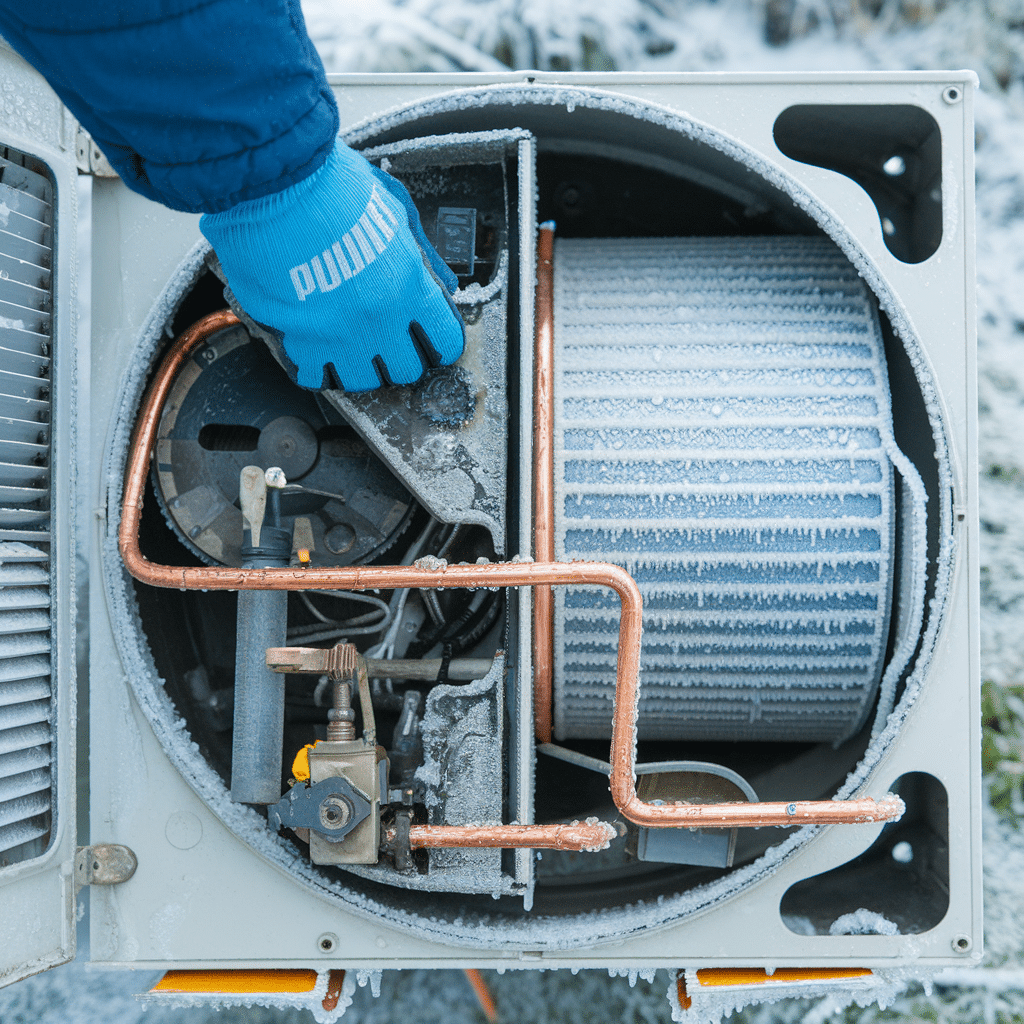
**Visible ice accumulation** is the most obvious indicator. Check the copper refrigerant lines running from your outdoor condenser to your indoor air handler. If you see frost or ice forming on these lines, your system is freezing. The ice may appear as a thin frost layer initially, then progress to thick ice buildup that completely covers the pipes.
**Dramatically reduced airflow** from your vents indicates that ice is blocking the coils. Your system may be running, but barely any air comes through the registers. Rooms feel stuffy despite the thermostat calling for cooling. This restricted airflow is particularly noticeable in homes near Pacific City or along the coast, where residents expect consistent cooling performance.
**Water pooling** around your indoor unit or dripping from ceiling vents happens when ice melts faster than your drain pan can handle. The condensate drain line becomes overwhelmed, leading to water damage on ceilings, walls, or floors. In two-story homes common throughout Huntington Beach, this often manifests as ceiling stains in rooms below attic-mounted air handlers.
**Unusual hissing or bubbling sounds** coming from your AC indicate refrigerant issues often associated with freezing. The compressor may cycle on and off more frequently than normal, or you might hear gurgling in the refrigerant lines.
**Higher-than-normal humidity** inside your home occurs because frozen coils can’t remove moisture from the air. Even with your AC running constantly, your home feels clammy and uncomfortable—exactly what you don’t want during those humid September mornings when the marine layer lingers.
Immediate Steps to Take When You Discover Ice Buildup
When you discover frozen coils on your Huntington Beach AC system, taking the right immediate actions prevents compressor damage and gives your system the best chance of recovery:
**Turn off your air conditioner immediately** at the thermostat. Set it to “Off” rather than just raising the temperature. Continuing to run a frozen system forces your compressor to work against the ice blockage, which can burn out this expensive component. Given that compressor replacement can cost $1,500-$2,500, this simple step protects your investment.
**Turn on the fan setting** to “On” (not “Auto”) at your thermostat if your system allows it. Running just the blower fan—without the cooling cycle—helps speed the thawing process by circulating warm air over the frozen coils. This approach works well in most Huntington Beach homes where ambient temperatures are moderate.
**Place towels or a shallow pan** under your indoor unit to catch water as the ice melts. Depending on how much ice has accumulated, you may see significant water discharge. Check the area every 30-60 minutes and replace saturated towels. This is especially important for attic-mounted units common in Seacliff and Goldenwest neighborhoods, where water can quickly damage ceilings.
**Check and replace your air filter** while waiting for the ice to melt. A severely clogged filter is the most common cause of frozen coils. In Huntington Beach’s sandy, coastal environment, filters can clog faster than the standard 30-day replacement schedule. If your filter looks gray or you can’t see light through it, replace it immediately.
**Allow 2-8 hours for complete thawing** depending on the severity of ice buildup. Don’t restart your system until all ice has melted from the refrigerant lines and coils. Running the system before it’s fully thawed will cause immediate re-freezing.
**Inspect your outdoor condenser unit** for obvious blockages. Clear away any vegetation, debris, or items stored too close to the unit. Many Huntington Beach homes have landscaping near their outdoor units that can restrict airflow, contributing to system imbalance and freezing.
If you need immediate assistance or the problem persists after thawing, AC repair in Huntington Beach services from Shalom Heating & Air can diagnose and resolve the underlying issue quickly.
Common Causes Behind Frozen AC Coils in Southern California Homes
Understanding why your AC froze helps prevent recurrence. Several factors specific to Huntington Beach’s coastal environment contribute to this problem:
**Restricted airflow from dirty filters** tops the list. When filters become clogged with dust, sand, and salt particles common in coastal areas, airflow across the evaporator coils decreases dramatically. The refrigerant inside the coils doesn’t absorb enough heat from the restricted air, causing temperatures to drop below freezing. Huntington Beach’s proximity to both ocean spray and inland dust corridors means filters accumulate debris faster than in many California communities.
**Low refrigerant levels** from slow leaks cause pressure imbalances that lead to freezing. Refrigerant doesn’t “get used up”—if levels are low, there’s a leak somewhere in your system. Low refrigerant reduces pressure in the evaporator coils, causing extreme temperature drops. This issue requires professional diagnosis and repair, as federal regulations govern refrigerant handling.
**Blocked or closed supply vents** throughout your home force air to recirculate improperly. Many homeowners close vents in unused rooms thinking they’ll save energy, but this actually disrupts system balance and can cause freezing. Your HVAC system was designed to distribute air throughout your entire home—closing vents in bedrooms or guest rooms creates back-pressure that affects the evaporator coils.
**Dirty evaporator coils** themselves restrict heat transfer. Over time, dust, pet dander, and other airborne particles coat the coils inside your air handler. This insulating layer prevents proper heat exchange, causing coil temperatures to plummet. Professional coil cleaning during regular maintenance prevents this issue.
**Thermostat problems** can cause your system to run continuously without cycling off properly. If your thermostat is located in a problematic spot—like near a window where afternoon sun skews readings, or in a hallway that doesn’t represent your home’s actual temperature—it may keep your system running too long, eventually freezing the coils.
**Blower fan malfunctions** reduce air movement across the coils. A failing blower motor, loose fan belt, or electrical issue affecting fan speed can all restrict airflow enough to cause freezing. You might notice that your system seems quieter than usual, which often indicates the blower isn’t operating at full capacity.
**Drainage problems** can contribute to ice formation. If your condensate drain line is clogged, water backs up and can freeze. This is particularly common in Huntington Beach’s coastal humidity, where algae and mineral deposits build up faster in drain lines.
**Operating your AC during cool weather** stresses the system in ways it wasn’t designed to handle. Running air conditioning when outdoor temperatures drop below 60°F—common during Huntington Beach’s cool spring mornings or marine-layer days—can cause freezing because the system can’t discharge heat properly through the outdoor condenser.
For comprehensive diagnostics of freezing issues and other cooling problems, explore our complete range of HVAC services in Huntington Beach.
When to Call Professional AC Repair Services
While changing filters and clearing vents are homeowner-friendly tasks, certain frozen coil situations require professional expertise:
**Call immediately if** ice reforms within hours of thawing and restarting your system, even after replacing filters. This indicates a refrigerant leak, compressor issue, or airflow problem that needs professional diagnosis. Repeated freezing accelerates wear on your compressor and can lead to complete system failure.
**Professional help is essential** if you hear grinding, squealing, or clicking noises from your indoor or outdoor unit. These sounds often indicate mechanical problems with the blower motor, compressor, or fan that contribute to freezing and will worsen without repair.
**Don’t delay calling if** you notice water damage to ceilings, walls, or floors from overflowing drain pans. Water infiltration can cause mold growth within 24-48 hours, creating both property damage and health concerns. Professional technicians can assess both the HVAC issue and potential moisture intrusion.
**Refrigerant-related freezing requires licensed technicians**. EPA regulations mandate that only certified professionals can handle refrigerant. If your system needs refrigerant added, there’s a leak that must be located and repaired—simply adding refrigerant without fixing the leak wastes money and harms the environment.
**Age-related freezing in systems over 12-15 years old** may indicate that multiple components are failing simultaneously. A professional assessment can help you understand whether repair or replacement makes better financial sense. For Huntington Beach homeowners with high property values, investing in a new, efficient system often provides better long-term value than repeated repairs on aging equipment.
**Coastal corrosion issues** are particularly relevant for Huntington Beach homes near the ocean. Salt air accelerates deterioration of coils, refrigerant lines, and electrical components. If your freezing problem coincides with visible corrosion on your outdoor condenser, professional evaluation can determine whether repairs or replacement better serves your needs.
Shalom Heating & Air provides same-day service throughout Huntington Beach, from homes near Huntington Beach Pier to properties in Huntington Harbour. Our technicians carry diagnostic equipment to identify refrigerant leaks, measure airflow, check refrigerant pressures, and assess blower motor performance—all the factors that contribute to frozen coils.
Preventing Future Freezing Problems in Coastal California
Prevention is significantly less expensive than emergency repairs. Huntington Beach homeowners can take these proactive steps to avoid frozen coils:
**Replace filters more frequently** than the manufacturer’s standard recommendation. In coastal environments, consider changing filters every 20-30 days rather than the typical 60-90 day interval. High-quality pleated filters capture more particles but may also restrict airflow faster—balance filtration with airflow needs.
**Schedule professional maintenance twice annually**—once before cooling season and once before heating season. Professional maintenance includes coil cleaning, refrigerant level checks, blower motor inspection, and condensate drain clearing. This preventive service catches small problems before they cause freezing or system failure. Many Huntington Beach homeowners find that indoor air quality in Huntington Beach improves dramatically with regular professional maintenance.
**Keep all supply vents open** throughout your home, even in unused rooms. If you want to reduce air to certain areas, partially close vents rather than closing them completely. Never close more than 20% of your home’s vents, as this creates system imbalance.
**Maintain clearance around your outdoor condenser**. Keep vegetation trimmed back at least 2-3 feet on all sides. Remove leaves, grass clippings, and debris that accumulate on or around the unit. Huntington Beach’s coastal landscaping—from salt-tolerant succulents to native plants—requires regular maintenance to prevent it from obstructing HVAC equipment.
**Monitor your thermostat location and settings**. If your thermostat is in direct sunlight, near a door, or in an unrepresentative location, consider relocating it or upgrading to a smart thermostat with remote sensors. Set reasonable temperatures rather than extremely cold settings—lowering your thermostat to 68°F when it’s 85°F outside won’t cool your home faster and may cause freezing.
**Address humidity control** in your home. Excessive indoor humidity makes your AC work harder and can contribute to freezing problems. If you notice condensation on windows or consistently high humidity, consider a whole-home dehumidifier or ensure your bathroom and kitchen exhaust fans vent properly to the outside.
**Inspect ductwork annually** for leaks, especially in attic installations common throughout Huntington Beach. Leaking ducts reduce system efficiency by 20-30% and can contribute to freezing by altering airflow balance. Sealing ductwork often provides immediate improvement in system performance.
**Consider upgrading older systems**. Air conditioners over 15 years old operate significantly less efficiently than modern systems and are more prone to freezing and other problems. New systems often pay for themselves through energy savings while providing better comfort and reliability.
For homeowners concerned about operating costs, our guide on how much it costs to run AC in Huntington Beach provides detailed information on managing energy expenses while maintaining comfort.
The Real Cost of Ignoring Frozen AC Coils
Homeowners sometimes try to push through cooling problems, but ignoring frozen coils leads to progressively worse—and more expensive—problems:
**Compressor failure** is the most serious consequence. Your compressor is the most expensive component in your AC system, often costing $1,500-$2,500 to replace. When coils freeze, the compressor works against ice blockage, causing extreme stress. Compressor failure often means choosing between expensive repair and full system replacement.
**Water damage** from overflowing drain pans can cost thousands to repair. Ceiling repairs, drywall replacement, and mold remediation quickly exceed HVAC repair costs. In Huntington Beach homes where median values approach $980,000, protecting your property from water damage is essential.
**Mold growth in ductwork** creates health concerns and requires professional remediation. When frozen coils melt and overflow, moisture enters ductwork where mold spores thrive. Mold remediation can cost $2,000-$10,000 depending on the extent of growth and affected areas.
**Refrigerant leaks** worsen over time. Modern refrigerants are expensive, and EPA regulations mean that technicians can’t simply add refrigerant to a leaking system—the leak must be found and repaired first. Delaying repair allows more refrigerant to escape, increasing both repair costs and environmental impact.
**Complete loss of cooling** during hot weather creates health risks, especially for elderly residents or families with young children. Heat-related illness is a serious concern, even in Huntington Beach’s typically moderate climate. Those occasional 90°F+ days can be dangerous without working air conditioning.
**Reduced home value** can result from poorly maintained HVAC systems. When you eventually sell your home, a malfunctioning AC system becomes a negotiating point that can reduce your sale price or require expensive pre-sale repairs.
**Increased energy costs** mount while your system struggles. A freezing AC system runs constantly while providing little cooling, driving up electricity bills without delivering comfort. Many homeowners see bills increase 30-50% while dealing with freezing problems.
Shalom Heating & Air serves Huntington Beach and surrounding communities including Westminster, Newport Beach, and Fountain Valley. Our technicians understand the unique challenges that coastal California environments create for HVAC systems and provide solutions that address both immediate problems and long-term reliability.
When your AC coils freeze, quick action protects your system and your home. Whether you need emergency service, preventive maintenance, or system evaluation, call Shalom Heating & Air at (714) 886-2021 for professional service throughout the Huntington Beach area.
❓ Frequently Asked Questions
Why does my AC freeze up even though it's not extremely hot in Huntington Beach?
AC coils can freeze regardless of outdoor temperature. Freezing happens when airflow across the evaporator coils becomes restricted—usually from dirty filters, blocked vents, or low refrigerant levels—causing coil temperatures to drop below 32°F. Huntington Beach's coastal environment accelerates filter clogging with salt air and sand, making freezing possible even on moderate-temperature days. The problem stems from inadequate heat exchange at the coils, not outdoor heat levels. If your system freezes repeatedly, call Shalom Heating & Air at (714) 886-2021 for professional diagnosis of the underlying cause.
How long does it take for frozen AC coils to thaw completely?
Complete thawing typically takes 2-8 hours depending on how much ice has accumulated. Turn off the cooling system but run the fan setting on "On" to circulate warm air over the coils, which speeds the process. Severe ice buildup may require 6-8 hours to thaw completely. Never restart your AC until all ice has melted from the refrigerant lines—starting too soon causes immediate re-freezing and potential compressor damage. Place towels or pans under your indoor unit to catch water as ice melts. If coils refreeze shortly after restarting, you have an underlying problem requiring professional repair from Shalom Heating & Air.
Can I prevent my AC from freezing by setting the thermostat higher?
While extremely low thermostat settings can contribute to freezing, the primary causes are airflow restriction (dirty filters, blocked vents, closed registers) or refrigerant problems. Setting your thermostat higher doesn't fix these underlying issues. However, setting a reasonable temperature—around 72-76°F rather than 68°F or below—does reduce system stress and makes freezing less likely. The most effective prevention includes replacing filters every 20-30 days in Huntington Beach's coastal environment, keeping all vents open, and scheduling professional maintenance twice yearly. If your system freezes even at reasonable temperature settings, call Shalom Heating & Air at (714) 886-2021 to identify the real cause.
Is frozen AC dangerous or just inconvenient?
Frozen AC coils create multiple risks beyond inconvenience. Continuing to run a frozen system can burn out the compressor—the most expensive component to replace, costing $1,500-$2,500. As ice melts, overflowing drain pans cause water damage to ceilings, walls, and floors, potentially leading to mold growth that requires expensive remediation. Low refrigerant levels that cause freezing release harmful chemicals into the environment. In Huntington Beach's high-value homes, frozen coils left unaddressed can cause thousands in property damage beyond HVAC repair costs. Turn off your system immediately when you discover freezing, allow complete thawing, and contact Shalom Heating & Air if the problem persists or returns after restart.
📖 More Tips for Huntington Beach
-
 How Much Does It Cost to Run AC in Huntington Beach?
Wondering how much it costs to run your air conditioner in Huntington Beach? This guide breaks down average…
-
 Attic Furnace Replacement to Electric Heat Pump in Huntington Beach
Replacing a traditional gas furnace with an all-electric heat pump in a Huntington Beach attic is a smart…


