What Did This Project Involve?
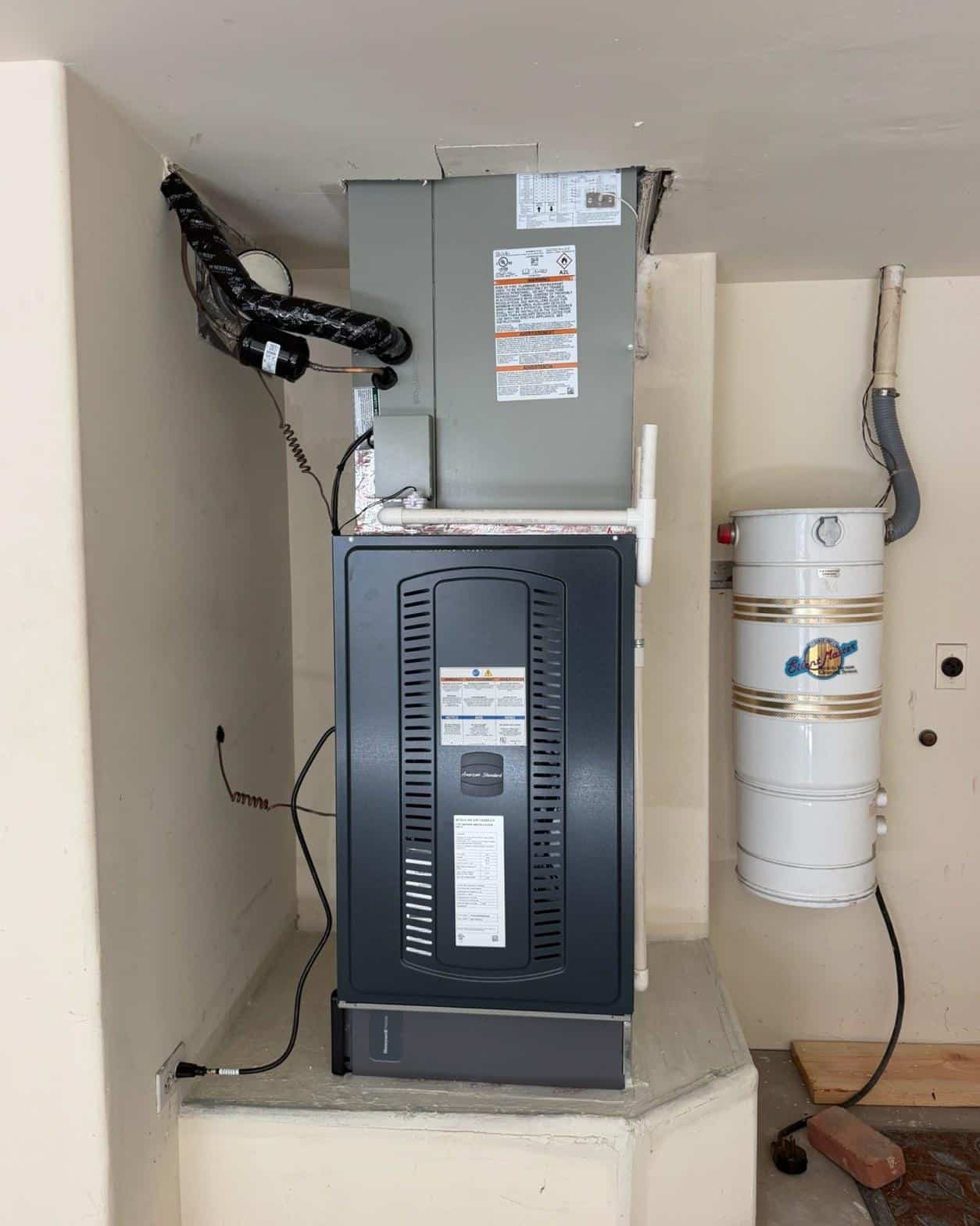
This job was a full HVAC system replacement: a new American Standard gas furnace and a matching air handler installed inside a utility closet in a Marina Del Rey home. The homeowner’s existing system had reached the end of its serviceable life, and with coastal Southern California winters keeping nighttime lows consistently in the 45°F to 55°F range according to NOAA climate data for the Los Angeles basin, reliable heating is not optional.
The goal was straightforward: remove the old equipment, set new units in the same footprint, and restore full heating and cooling capability without disrupting the rest of the home. The utility closet presented the typical challenges of a tight installation, with limited clearance on three sides and an existing central vacuum unit already sharing the right-hand wall. Good planning before the first bolt was turned made the difference between a clean install and a frustrating one.
How Was the Furnace Positioned and Supported?
The furnace sits on a raised concrete platform inside the closet, which keeps the unit off the slab, improves combustion airflow at the base, and protects the cabinet from any incidental moisture on the floor. This is the correct approach for closet installations, and it matches the manufacturer’s installation requirements for this class of upflow furnace.
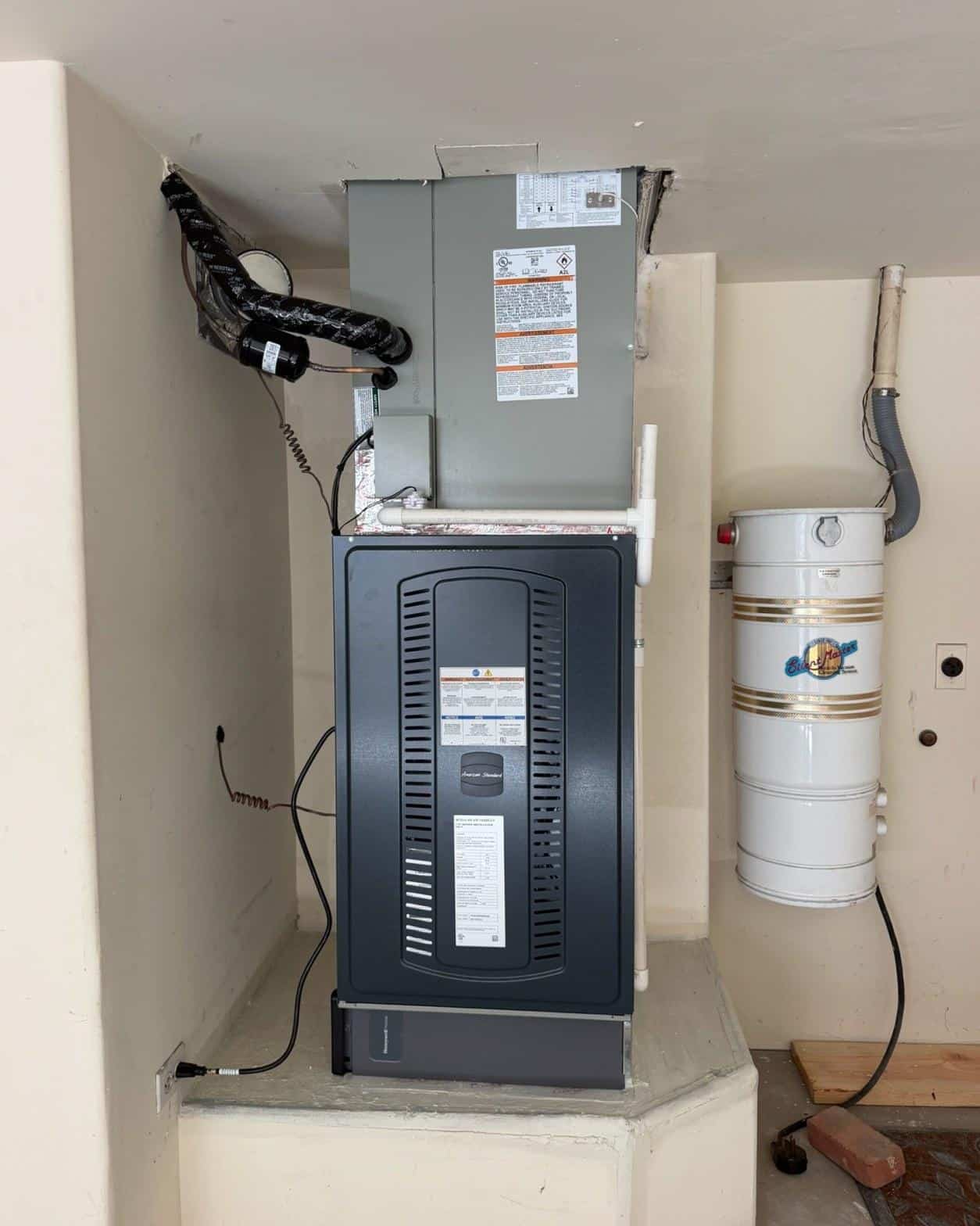
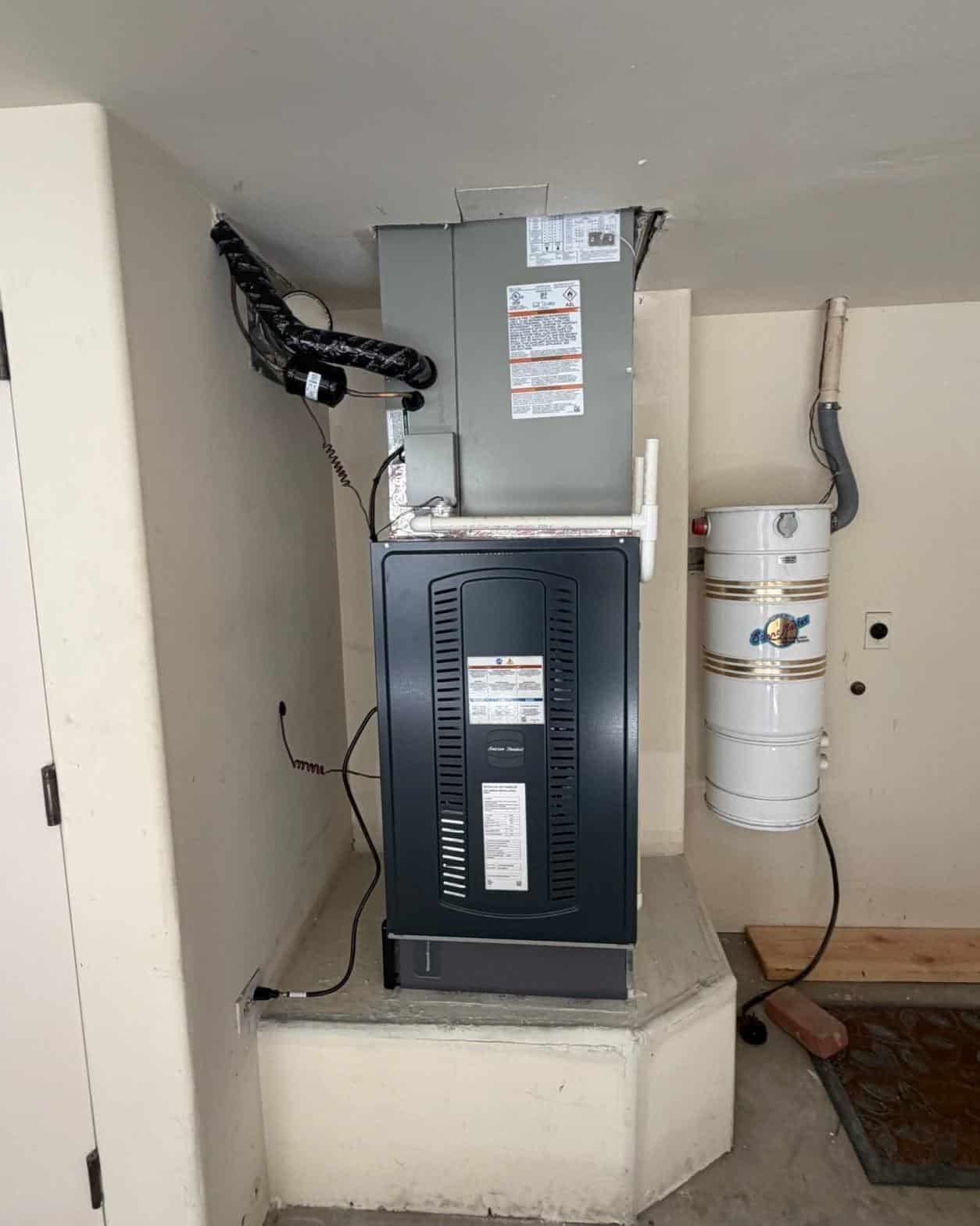
The American Standard unit itself is a dark-cabinet upflow gas furnace with a louvered front panel for combustion air. The air handler is stacked directly above it, fed by flexible, insulated duct collars that tie into the home’s existing duct system through the ceiling. A PVC condensate drain line runs vertically from the air handler coil, then turns horizontally to route drainage away from the equipment. Getting that drain slope right matters: a line with insufficient pitch will back up and eventually flood the closet floor, so our technicians verified the fall across the entire drain run before buttoning up.
With the furnace sitting on the platform and the air handler mounted above, the combined stack height comes close to the ceiling of the closet. That tight vertical clearance is visible in the photo, and it required careful sequencing during installation: the furnace was positioned and secured first, the coil cabinet was set second, and the duct connections were made from above before the closet door clearances were confirmed. A central vacuum canister is visible on the right-hand wall, and routing the new duct connections without conflicting with the vacuum exhaust line took deliberate coordination.
What Makes This System a Good Fit for a Coastal Home?
An American Standard gas furnace paired with a dedicated air handler is well suited to a home that already has existing ductwork, because the split configuration lets the equipment slot into the same closet footprint as the previous system without a major duct rebuild. It also means the homeowner retains the option to add or upgrade a matched condensing unit outdoors for cooling without replacing the air handler again.
Modern gas furnaces in this category carry AFUE ratings of 80% or higher, with high-efficiency models reaching 96% AFUE. Even at 80% AFUE, the efficiency improvement over a furnace more than 15 years old, which might operate at 60% to 70% AFUE, translates to real monthly savings on the gas bill.
For homeowners considering a new furnace purchase, it is worth noting that under the Inflation Reduction Act federal tax credit, qualifying high-efficiency gas furnaces may be eligible for a federal tax credit of up to $600 as of 2026. Our technicians handle roughly 3 to 4 utility-closet furnace swaps per month in coastal Los Angeles neighborhoods, and in almost every case the homeowner had been running equipment that was 15 to 20 years past its optimal service life.
Why the Utility Closet Layout Matters
A utility closet installation demands tighter coordination than an attic or garage setup, because every inch of the space has a job to do. Combustion air supply, flue venting, condensate drainage, electrical connections, and duct transitions all have to coexist in a space that might be no larger than 4 feet by 4 feet.
In this installation, the flexible duct collars exiting the air handler at the top left of the closet are wrapped in insulation and routed into the existing ceiling plenum. That insulation is not optional: California’s Title 24 building energy standards require duct insulation to meet a minimum R-value, and uninsulated flex duct in a conditioned-space closet would fail inspection. The installation was permitted and inspected, which protects both the homeowner and the property’s resale value.
Shalom Heating & Air is Licensed by the California Contractors State License Board (CSLB), and every installation we complete is done to code so that permits close cleanly and the homeowner has full documentation in their records.
Ready to Replace Your Furnace or Air Handler?
If your heating system is more than 12 to 15 years old, or if you are noticing uneven heat, rising gas bills, or strange cycling behavior, a system evaluation is the right first step. Call Shalom Heating & Air to schedule a site visit and get a written equipment proposal before any work begins. We serve Marina Del Rey and surrounding neighborhoods throughout the Los Angeles basin.
Gallery
Explore our full range of HVAC services across Southern California.
Frequently Asked Questions
How long does it take to install a new furnace and air handler in a utility closet?
Most utility-closet furnace and air handler replacements take one full day, typically 6 to 8 hours, when the existing ductwork is being reused. If the duct connections need significant rework or the condensate drain has to be rerouted, the job can run into a second day. Having the equipment on-site before the technicians arrive is the single biggest factor in keeping the timeline on schedule.
Is a permit required to replace a furnace in California?
Yes. Furnace replacement is a permitted scope of work in California, and inspections are required to verify that the installation meets California's Title 24 building energy standards and local mechanical codes. A properly closed permit protects the homeowner at resale and confirms that the gas and electrical connections were inspected by a third party.
What is the AFUE rating and why does it matter when I am buying a new furnace?
AFUE stands for Annual Fuel Utilization Efficiency, and it measures what percentage of the gas your furnace burns actually becomes heat in your home. A furnace rated at 80% AFUE converts 80 cents of every dollar of gas into usable heat. Older furnaces from the early 2000s often ran at 60% to 70% AFUE, so upgrading to a current 80% or 96% AFUE unit can meaningfully reduce your monthly gas bill.
Can I get a federal tax credit for installing a new gas furnace?
As of 2026, the Inflation Reduction Act federal tax credit allows homeowners to claim up to $600 for a qualifying high-efficiency gas furnace. Eligibility depends on the unit's AFUE rating meeting the IRS threshold, and the credit applies to equipment installed in an existing primary residence. A tax professional can confirm your specific situation.
Why is the furnace sitting on a raised platform inside the closet?
Raising the furnace on a concrete platform keeps the cabinet off the slab, which protects against moisture and improves combustion airflow at the base of the unit. Most furnace manufacturers require a minimum clearance between the bottom of the cabinet and the floor, and a concrete curb is the most durable way to meet that requirement in a closet installation.
How do I know if my existing air handler can be kept when I replace the furnace?
The air handler and furnace should be matched by the same manufacturer and sized to the same tonnage for peak efficiency and reliability. If the existing air handler is more than 10 to 12 years old, uses an older refrigerant, or shows signs of coil corrosion or cabinet damage, replacing both units at the same time usually costs less in the long run than replacing them separately over a short period.
Passionate - Dedicated - Professional