What Was Wrong with the Old System
The rooftop package unit at this Norwalk home had reached the end of its service life, showing heavy rust on its housing and flex ducts that were literally falling apart. A rooftop package unit combines the air handler, evaporator coil, and condenser into a single cabinet mounted directly on the roof, which means every part of the system is exposed to full sun, wind, and temperature swings year-round. In Norwalk, where summer afternoon temperatures regularly push past 95°F, that exposure accelerates wear considerably.
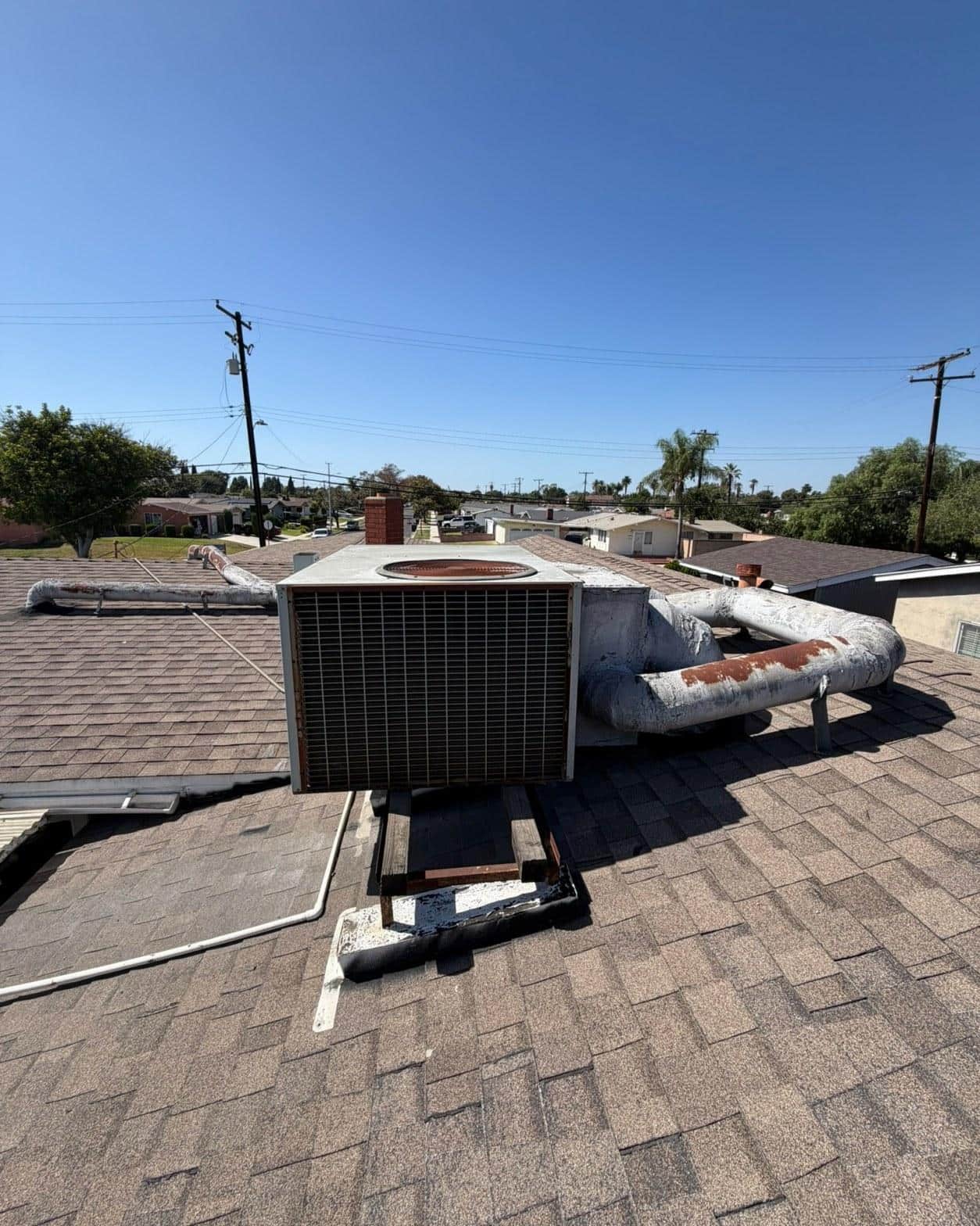
Looking at the old unit, the problems were impossible to miss. The sheet metal casing had rusted through in multiple spots, the condenser coil guard was caked with years of debris, and the two large flex ducts connecting the unit to the home’s interior supply and return were crumbling. Flex duct insulation that is compromised loses its thermal integrity fast, conditioned air traveling through a deteriorated duct picks up heat before it ever reaches a living space, forcing the system to run longer cycles and driving up electricity costs. Our technicians see this duct degradation pattern on rooftop units that are 15 or more years old, particularly when the original flex was installed without UV-resistant jacketing.
Why a Full Replacement Made More Sense Than Repair
When a rooftop package unit shows rust penetration on the cabinet and collapsed ductwork simultaneously, repair costs typically exceed 50% of a new unit’s price, the threshold most HVAC engineers use to recommend full replacement. The compressor, coil, and heat exchanger all share that same degraded housing, meaning repairing one component leaves the others at risk.
There was another practical reason to replace now. As of 2023, ENERGY STAR minimum efficiency standards for residential central air systems require a SEER2 rating of at least 14.3 in California’s climate zones. The outgoing unit predated those standards by years and was almost certainly operating well below that efficiency floor, especially in its degraded state. A new unit brings the home into compliance and lowers monthly operating costs from day one.
Under the Inflation Reduction Act federal tax credit program, homeowners who install qualifying high-efficiency HVAC equipment may claim up to 30% of the project cost, capped at $600 for central air systems, on their federal return. It is worth confirming eligibility with a tax professional before filing.
How the Replacement Was Done
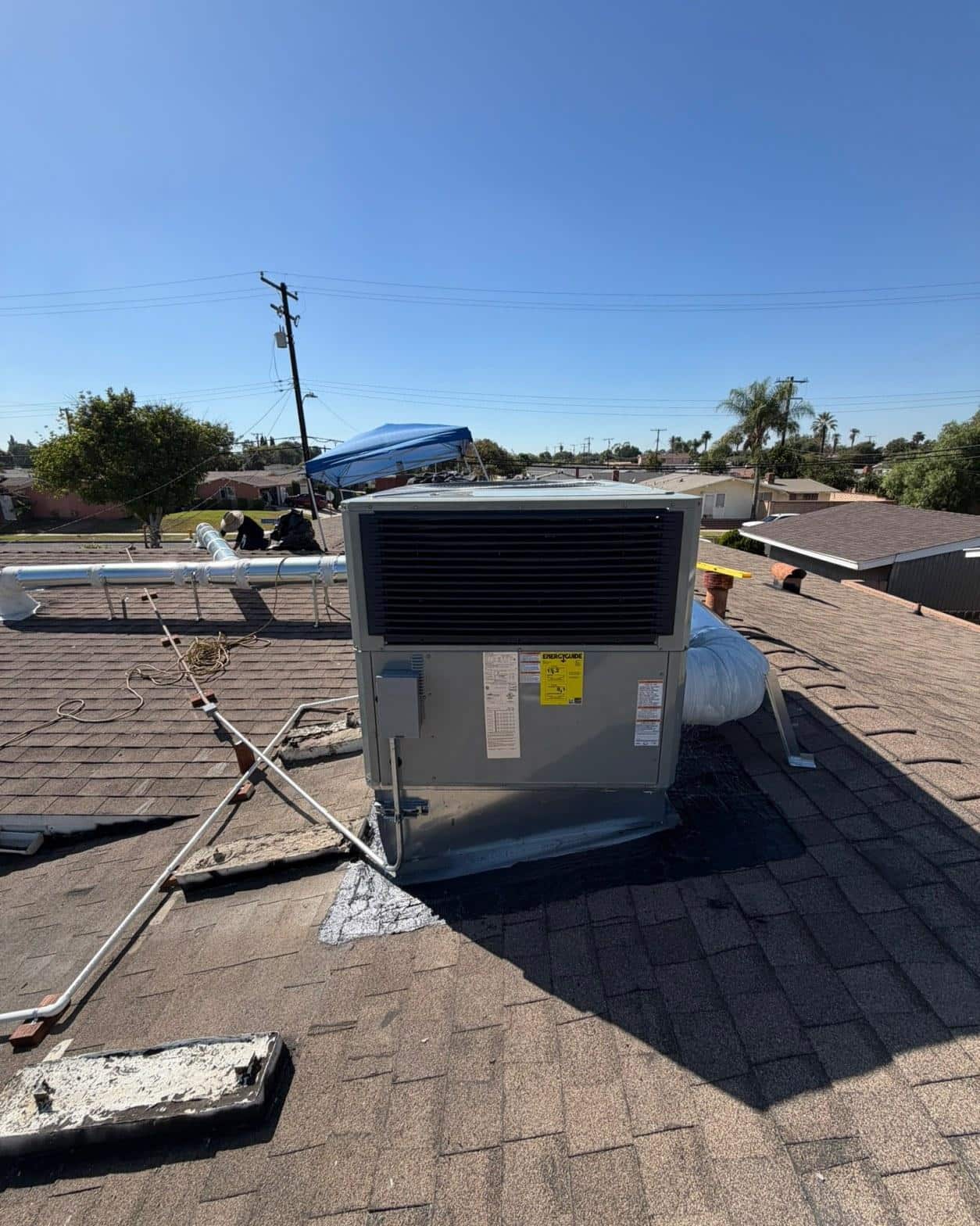
The crew disconnected and lifted the old 4-ton unit off the roof curb, removed the deteriorated flex duct runs, and set the new package unit in place using the existing roof curb after verifying it was structurally sound. The new connections visible in the after photo use a rigid insulated duct collar rather than flex, which holds its shape under foot traffic and UV exposure far better than a flex duct assembly.
Proper rooftop unit installation also requires careful attention to the curb seal. Any gap between the unit base and the roof curb is a direct path for water intrusion into the ceiling. The team sealed and flashed the curb perimeter before setting the unit, protecting the asphalt shingles beneath.
The new unit carries a yellow EnergyGuide label, visible in the featured photo, confirming its rated efficiency has been third-party verified before it ever left the factory.
The Transformation, Before and After
Side by side, the contrast between the two systems is striking. The old unit’s brown rust streaks, collapsed flex arms, and faded housing tell the story of a system well past its design life. The new cabinet is clean, square, and properly integrated with the roof surface. The rigid duct collar exits the unit at a controlled angle rather than slumping under its own weight.
For the homeowner, the practical change is equally clear: a system that was likely struggling to hold indoor temperatures during peak heat is now replaced with a properly sized 4-ton unit matched to the home’s cooling load. A 4-ton system is designed to handle approximately 48,000 BTU per hour of cooling, which suits a home in the roughly 2,000 to 2,400 square foot range depending on insulation, window area, and ceiling height.
Schedule Your Rooftop HVAC Service in Norwalk
If your rooftop package unit is showing rust, reduced airflow, or flex ducts that look anything like the before photo above, get it inspected before the next heat season. Shalom Heating & Air is Licensed by the California Contractors State License Board (CSLB) and serves Norwalk and surrounding communities. Call to schedule an assessment or request a written quote for a replacement unit.
Frequently Asked Questions
How long does a rooftop package unit usually last before it needs replacing?
Most rooftop package units have a design life of 15 to 20 years under normal conditions. Units exposed to intense sun and heat without regular maintenance, as is common in Norwalk and the greater Los Angeles area, often show significant deterioration by year 12 to 15, particularly in the ductwork and cabinet casing.
What size rooftop package unit do I need for my house?
A 4-ton rooftop package unit, like the one installed on this Norwalk home, is typically sized for homes in the 2,000 to 2,400 square foot range. Proper sizing requires a Manual J load calculation that accounts for insulation levels, window area, ceiling height, and local climate data, an oversized or undersized unit will short-cycle or run continuously, both of which raise energy costs.
Can I get a tax credit if I replace my AC unit in 2025 or 2026?
Homeowners who install a qualifying high-efficiency central air system may claim a federal tax credit of up to 30% of the installed cost, capped at $600 for central air conditioners, through the Inflation Reduction Act federal tax credit program. Confirm your specific equipment's eligibility with a tax professional, since efficiency thresholds apply.
Why is my rooftop AC blowing warm air even though it's running?
Deteriorated or collapsed flex ductwork is one of the most common causes of warm air from a rooftop system. When the duct insulation breaks down, conditioned air absorbs heat from the attic or outdoor environment before reaching the living space. A refrigerant leak or a failing compressor can also cause warm airflow and should be diagnosed by a licensed HVAC technician.
How much does a rooftop package unit replacement cost?
A residential 4-ton rooftop package unit replacement in Southern California generally runs between $4,500 and $9,000 installed, depending on equipment efficiency rating, ductwork condition, and roof curb compatibility. Units requiring a new curb or extensive duct rework fall toward the higher end of that range.
Do I need a permit to replace a rooftop AC unit in Norwalk, California?
Yes. The City of Norwalk requires a mechanical permit for HVAC equipment replacement, and the work must be performed by or under a contractor Licensed by the California Contractors State License Board (CSLB). The permit process ensures the installation is inspected for compliance with California's Title 24 building energy standards.
Passionate - Dedicated - Professional